



Beachvolleyballexercises
Last update: january 2026
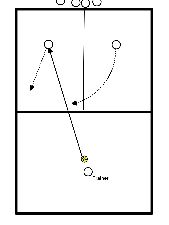
Explanation of Shoot-out with Own Defender in the Far Corner (Preferably)
- The player throws the ball with one foot on the transition from sideline to goal line (side can be chosen).
- The defender runs to the outside (line of sight).
- The player moves inside and catches the ball at least three steps from the line.
- Finish with a pirouette or a single jump shot.
- Watch out for the advancing defender/blocker!
- The five players chosen for the shoot-out are not allowed to defend or block.
Game Description
- Shooting game where players may draw a card after scoring. Each playing card has a suit: clubs, spades, hearts, or diamonds. Each suit corresponds to a fitness exercise.
- Hearts: Push-ups
- Spades: Squats
- Clubs: Burpees
- Diamonds: Lunges
- After drawing a card, perform the corresponding exercise. The number of repetitions is equal to the value of the card. For example: Hearts 4 = 4 push-ups. Continue shooting afterwards. The group with the most cards wins.
Execution
- The player jumps over the hurdle and then jumps from that spot with one leg into the hoop and back again for the next hurdle. Repeat this until the end.
- Jump sideways over the hurdle and then with one leg into the two hoops. At the outer hoop, jump back over the hoop next to the hurdle.
- Jump sideways over one hurdle and back. With one large step, jump to the other hurdle, jump over it and back, and then sprint to the cone.
- Finish with a jump over the ladder.
Formation
- Two teams of a maximum of 4 people.
- 1 ball.
- On both sides, 2 people on the court, others behind the baseline.
- Score in one attempt in the other court (within the lines).
- Start with a simple underhand service.
- We play underhand tennis, so over the net in one attempt.
- A difficult ball may bounce once, but then the ball must be returned with one hand, a foot, or the head.
- Made a mistake? Leave the court to the baseline, a new player takes over.
Execution
- Jump on your left foot for 10 seconds on the spot and maintain balance.
- Sprint to the red line.
- Repeat on your right foot and sprint again to the red line.
- Perform knee lifts on the spot for 10 seconds, stay on your toes for speed.
- Sprint to the red line.
- Do 5 lunges with the right leg and 5 with the left leg.
- Sprint to the red line.
- Jump sideways over the line 3 times back and forth.
- Sprint to the red line.
- Repeat the sideways jumps with your back to the court.
Objective
- Collect as many cards as possible by scoring and perform the corresponding fitness exercises.
- Upon scoring, a player may pick a card.
- Each playing card has a suit: clubs, spades, hearts, or diamonds.
- Each suit corresponds to a specific fitness exercise:
- Hearts: Push-ups
- Spades: Squats
- Clubs: Burpees
- Diamonds: Lunges
- Perform the exercise the number of times indicated on the card. For example, Hearts 4 = 4 push-ups.
- After completing the exercise, the player can continue shooting.
- The group with the most cards wins.
Formation
- The group is positioned at the four corners of the court. One player is the tagger and wears a team ribbon.
- On a signal, the players cross the court in three possible directions: the short side, the long side, or diagonally. Upon returning to their corner, they earn one, two, or three points respectively.
- The tagger tries to tag players. Tagged players must return to their corner before they can cross again.
- Try to score as many points as possible within the agreed time.
Running Training
- 30 seconds Jumping Jacks
- 30 seconds High Knees
- 30 seconds Heels to Buttocks
- 30 seconds Bridge with One Foot on Ball
- 30 seconds Jump Lunge Passing Ball Between Legs
- 30 seconds Skater Jumps
- 30 seconds Russian Twist (Feet Off the Floor)
- Build Up Burpees Starting from 25
- 30 seconds Regular Plank
- 30 seconds Alternately Lift Left and Right Leg
- 30 seconds Side Plank on Right Side, Other Arm Extended
- 30 seconds Side Plank on Left Side, Other Arm Extended
- 30 seconds Regular Plank
- 30 seconds Spiderman Plank
- Bicycle Crunch 2 x 1 minute (20 seconds rest)
- 3 x 8 Plyometric Clap Push-Ups
Execution
- Set up an attack on one side. The blocker stands in front of the attacker, pretends to jump, and steps back.
- The attacker plays a short ball over the blocker.
- The blocker defends the ball, after which the rally continues or the ball is scored.
- When the attacker comes to the middle, you can train on both sides. The same applies when the attacker plays a short diagonal ball.
- The blocker makes a step in the diagonal, pretends to jump, and then runs to defend the diagonal ball.
- The first ball must be played short. Afterwards, play against each other for the point.
- Apply it in a situation where the attacker has no restrictions. The trainer or a player throws the first ball from a table.
- The attacker may try to score the ball in the area just behind the net, along the line, or diagonally.
Execution
- The first player serves the ball to a specific area on the court.
- The other players must serve to the same area.
- Anyone who does not hit the target area receives a letter.
- The first player to collect all the letters of the pre-determined word loses the game.
- As long as the ball lands within the target area, any type of serve is sufficient.
- Increase the serving distance. Start at 5 metres and execute. Repeat at 6 metres and so on, especially for younger players.
- If the first player hits the target area with a jump serve, the following players must also hit the area with a jump serve.
Introduction
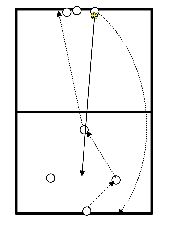
- First, explain the theory of the pass.
- Illustrate the situation in the sand.
- Keep the ball on your own side and one metre from the net.
- The other player runs a banana or crescent route.
- The players stand together on the court and deliver a service pass.
- The setter runs the discussed path and catches the ball.
- Add a set and attack to make the exercise more challenging.
Jumping in Place
- Stand with your feet shoulder-width apart.
- Focus on a point on the floor and jump up and down on the spot where you stand.
- Stand upright, keep your hands in front of you and jump from side to side.
- Stand upright and keep running on the spot while kicking your heel up to touch your buttocks with each step.
- Lift the leg with the knee at a 90-degree angle.
- Quickly alternate this with the other leg.
- Stand with your feet shoulder-width apart.
- Bring your knee to your opposite elbow.
- Return to the starting position and repeat with the other side.
- Stand with your feet 6-12 cm apart.
- Extend your arms in front of you.
- Lower your body until your thighs are parallel to the floor.
- Return to the starting position and repeat the exercise.
- Keep your arms by your side and pretend to hold the end of a skipping rope in each hand.
- Jump up and alternately land on the ball of each foot, while simultaneously rotating your wrists as if spinning a rope.
- Jump with both feet up, while simultaneously rotating your wrists as if spinning a rope.
- Stand on the ground with your arms straight out to the side at shoulder height.
- Move your arms quickly in large circles clockwise.
- Stand on the ground with your arms straight out to the side at shoulder height.
- Move your arms quickly in large circles counterclockwise.
- Start with your feet shoulder-width apart.
- Keep your legs and arms straight.
- Kick your left leg up until your right hand touches your toes.
- Repeat with the other side.
Execution
- Two receivers receive a service. The pass is caught, and the roles rotate: the receiver becomes the catcher, the catcher becomes the server, and the server becomes the reserve.
- Ensure that the pass remains on their own side and is at least one meter from the net.
- The catcher provides a set-up which is then hit.
- Two receivers receive a service again. After the service, the server quickly stands somewhere in the field.
- After the pass is made, the passer looks where the server is standing. A set-up and attack follow, aimed at the server.
- Roles rotate as follows: the server becomes the reserve receiver, the receiver who attacked becomes the setter, and the setter becomes the server.
Formation
- 1 server
- 1 receiver
- 1 setter
- 1 catcher
- Visualize an inverted triangle between the receiver and the setter, with the top at the receiver and the bottom against the net.
- Start with an easy serve.
- The pass should be directed to the corner of the triangle, most centrally in the field.
- The setter sets the ball to the other end, with a maximum distance of 2 meters.
- Use a standing basket for more accuracy.
- The coach plays the ball back to the receiver, repeat and catch or optionally play out.
- With 3 players: 1 receiver and 2 setters, coach serves.
- With 5 players: 2 setters alternate.
- With 6 players: divide into two groups and use both sides of the court.
- Work on the correct technique – turn towards the post before giving the set.
- Provide the set in a dynamic movement along the attacker's shoulder line.
- Use a standing leg in a slight lunge position to initiate the setup.
- Start with a very easy serve for consistent passes.
- Increase passing pressure with a more difficult serve.
- Let the setter start from a deeper point in the field.
- Let the setter start from a blocking position.
- Vary with set targets; increase or decrease the distance to the target, shift the target per set.
- Aim for 5 perfect passes and setups in a row.
- Engage the partner by providing feedback or by attacking the ball without jumping.
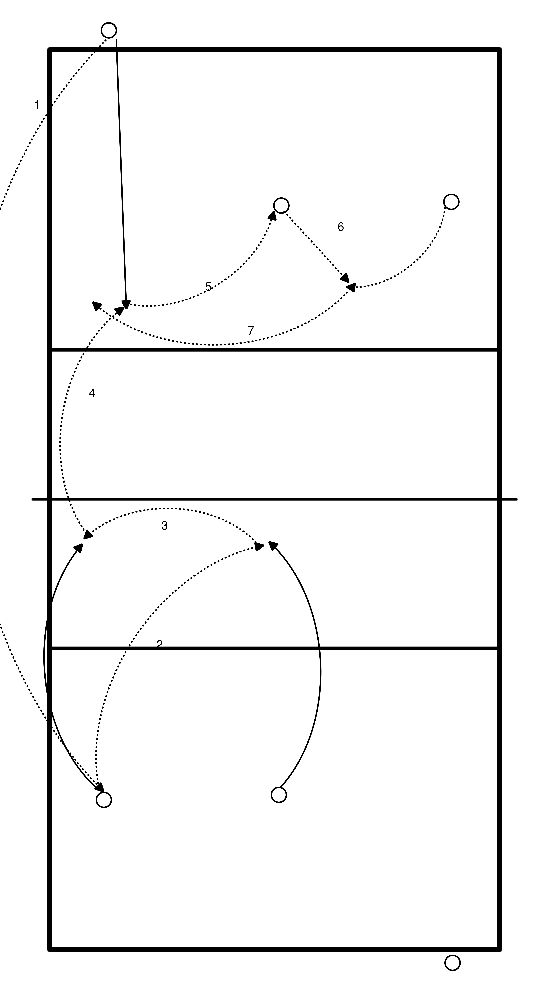
Organization
- 6 players per court.
- 2 players serving, each on either side of the net at position 1.
- Serve to position 5 or 6.
- Build up and place the ball to the server.
- The server defends to position 6.
- Player at position 6 makes the first contact.
- The previous attacker sets the ball to position 2 for the defending player.
- Continue as long as there are 2 balls. If 1 ball drops, play for the point.
- Observe if the defender is standing short or deep.
- A short ball is a pokey.
- A deep ball is a technical ball.
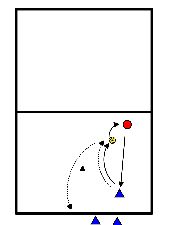
Execution
- Player at the net hits the ball to the defender.
- Defender controls the ball for themselves to the right place to provide a set-up.
- Defender moves and gives a set-up to the net player.
- Net player hits the ball to the next defender.
- After the set-up, the player joins the line with the defenders.
- Rotate after 10 balls.
- Control over the defense and preparation for a set-up.
- Ensure the set-up is high enough and on the correct "arm" for the attacker.
Objective
- The objective is to separate the elements and deliver quality. Pass the ball to the desired position. Then get into an attack position and execute the hitting technique. Here, preparation for the jump and reach height is essential.
- Both sides of the net are used. Player 1 stands on one side of the net, tosses the ball, and hits it to Player 2, who is in a service-receive position. It is important to use the desired technique when hitting. Player 2 passes the ball to the trainer. Pay attention to passing to the desired set position. The trainer catches the ball and immediately throws it in a perfect setup (starting with a 1-meter set that includes a peak). Player 2 gets into position for the attack and attacks in a specific area (use cones as a target). After the attack, the player moves to the serving position. After Player 1 has hit the ball, they join the line of passers/attackers.
- The attack direction is initially "only" right or left. As the exercise progresses, the target can be made smaller and more precise. The ball can also be tossed instead of hit by Player 1. Give Player 1 a more targeted assignment. Use a setter instead of the trainer who catches and throws the ball. Make attack zones smaller to increase the required precision. Build the attack from the serve and attack with a defense.
Setup:
Which team brings in most gold pieces/ pits?
Which team brings in most gold pieces/ pits?
- 1 bank & one-against-all
- 2-4 gangs of thieves
- 1-2 guards.
Game consists of 4 rounds of play:
Game Round 1:
Game Round 1:
- Thief - attacker: per post only 1 active & 1 gold piece at a time try to steal from bank.
- Collect in own vault -hoop-.
- Guard - defender- may only defend outside the bank.
- If the thief is caught so tapped, he must leave the gold piece in the police station -under a cone.
- Which team was able to steal most gold pieces?
Game Round 2:
- Divide gold pieces equally among the thieves.
- Thieves: safely move your gold pieces 1-for-1 to other safe -from one hoop to another.
- Thief -attacker: walk around your cone without the guard catching you.
- Agent -defender: in this case may only defend inside the bank.
- If the thief is caught -attacked, he must leave the gold piece in the police station -under a cone.
- Which team was able to transfer most gold pieces safely?
Game Round 3:
- Thieves: for x time, steal as many gold pieces as possible from other safe.
- Thief -attacker: mandatory back & forth through bank = watch for guard inside bank.
- Guard may only defend inside bank.
- If the thief is caught so tapped, he must leave the gold piece in the police station -under a cone.
Game round 4:
Same as game round 3, but with double guard 1 guard outside & 1 guard inside the bank.
Which team will have the most gold pieces in their possession after 4 rounds of play?
- Player at the net hits the ball to the defender.
- The latter defends the ball for himself to the appropriate place to give a set.
- He moves to there and gives a set to the net player.
- The latter passes the ball to the next defender.
- After the set, line up with the defenders.
- After 10 balls turn around .
Goal of this exercise is to control the defense and set up.
In setting; apply ball high enough and on the right "arm" for the attacker.
In setting; apply ball high enough and on the right "arm" for the attacker.
- Two passers receive a service.
- The pass is caught and the passer becomes the receiver, the receiver becomes the server and the server becomes the reserve.
- Make sure that the pass is held on the own half and at least one meter from the net.
This exercise can be extended by having the offender give a set-up which must then be hit.
Variant:
Variant:
- Two passers again receive a service, in the same way as the exercise before.
- After the serve the server quickly stands somewhere in the field.
- After the pass is given, the passer must look where the server is standing.
- Next comes a setup and attack.
The intention is to attack the server. The follow through is the same as the previous exercise. The server becomes the reserve server, the server who also attacked becomes the setter, and the setter becomes the server.
- Jump where you stand:
- Stand with your feet shoulder-width apart.
- Focus on a point on the floor and hop up and down where you are standing.
- Side Jump:
- Stand up straight, keeping your hands in front of you, and jump from side to side.
- Butt Kicks:
- Stand up straight, and keep running standing in place while shooting your heel up touching your buttocks with each step.
- High Stepping:
- Raise the leg with the knee at a 90-degree angle.
- Alternate quickly with the other leg.
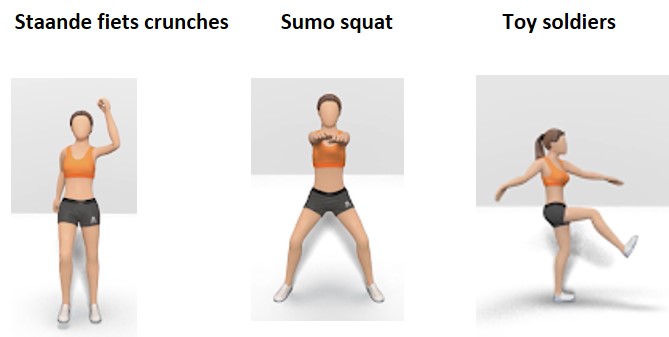
- Standing bike crunches:
- Stand with your feet shoulder-width apart.
- Bring your knee to your opposite elbow.
- Return to starting position and repeat with the other side (abdomen/legs).
- Sumo squat:
- Stand with feet 6-12 inches apart.
- Extend arms in front of you.
- Lower your body until your thighs are parallel to the floor.
- Return to starting position and repeat (legs / buttocks)
- Jumping rope without a rope:
- Hold your arms at your side as if you were holding the end of a jump rope in each hand.
- Jump up and come down on the ball of each foot, alternating between twisting your wrists as if you were spinning a rope.
- Jumpingrope without a rope:
- Keeping your arms at your sides, pretend you are holding the end of a jump rope in each hand.
- Jump up with 2 feet, while simultaneously twisting your wrists as if you were twirling a rope.
- Arm Swings clockwise:
- Stand on the floor with your arms extended straight out to the sides at shoulder height.
- Move your arms rapidly in a clockwise motion in large circles (arms)
- Arm Swings counterclockwise:
- Stand on the floor with arms extended straight out to the side at shoulder height.
- Move your arms quickly in large counterclockwise circles (arms)
- Toy soldiers:
- Start with feet shoulder-width apart. Keep your legs and arms extended.
- Kick your left leg up until your right hand touches your toes.
- Repeat with the other side (stomach/legs/arm/shoulder).
Organization: 6 players per court
- 2 on each side of the net, at position 1
- Storage to position 5 or 6, build-up and pass the ball to the server
- The server defends to position 6,
- This player executes the first contact
- and the previous attacker sets the ball to position 2
- the defence player
- As long as there are 2 balls, keep going, when one is dropped, go for the point.
Variant: the defender is short or deep, short ball is pokey, deep ball is technical ball.
Circulation warm-up
- This consists of a loose walk-in for 5 to 10 minutes with various light movements for arms, legs and torso.
- By doing this you actively bring the function of the heart, lungs, nervous system and muscular system to a higher level than the resting level.
Stretching
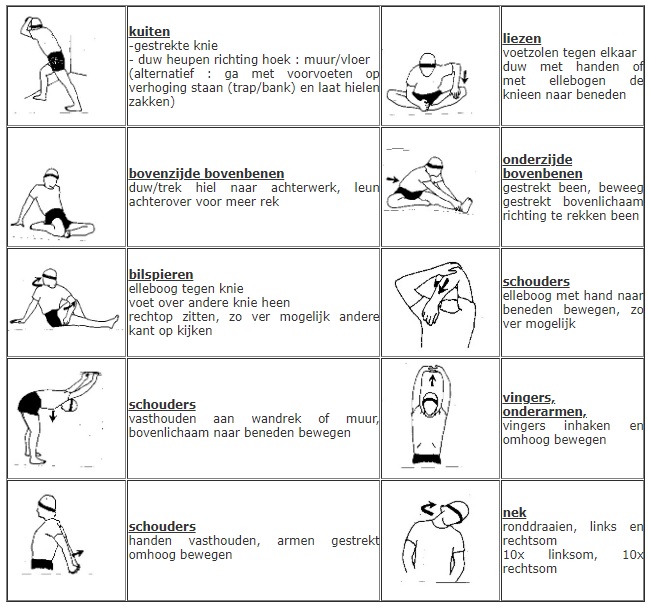
Do you want to get in shape? You can, but you need a few things for it.
- What do you need?
- Pawns
- Soccer
- Clothes you can work out in
- Stairs
- First of all, it's important that you warm up well before you start working on your fitness!
- What do you need to do?
- Run 2 cones to the front 1 to the back and repeat this every time.
- Do that twice
- Take the ball and run with it in 5 circles.
- This will give you ball control and also ensure that you have worked on your fitness for a while.
- You can also do exercises for your condition inside by running 5 times up and down the stairs.
- Run 2 cones to the front 1 to the back and repeat this every time.
- Of course you can give your own twist to how you want to do it, but I find these are the nicest and most fun ways to improve.
- Don't try to run fast the first day without stopping, do it in steps!
- The first player serves the ball to a certain area in the field.
- The other players must serve to the same area.
- Whoever does not hit the target area gets a letter.
- The first player to collect all the letters of the pre-conceived word has lost the game.
Adjustments
- As long as the ball is within the target area, any type of service will do.
- Increase the distance of the service.
- Start at 5 metres and execute.
- Repeat at 6 metres and so on.
- Especially with younger players.
- If the first player hits the target area with a jump service, the following players must also hit the area with a jump service
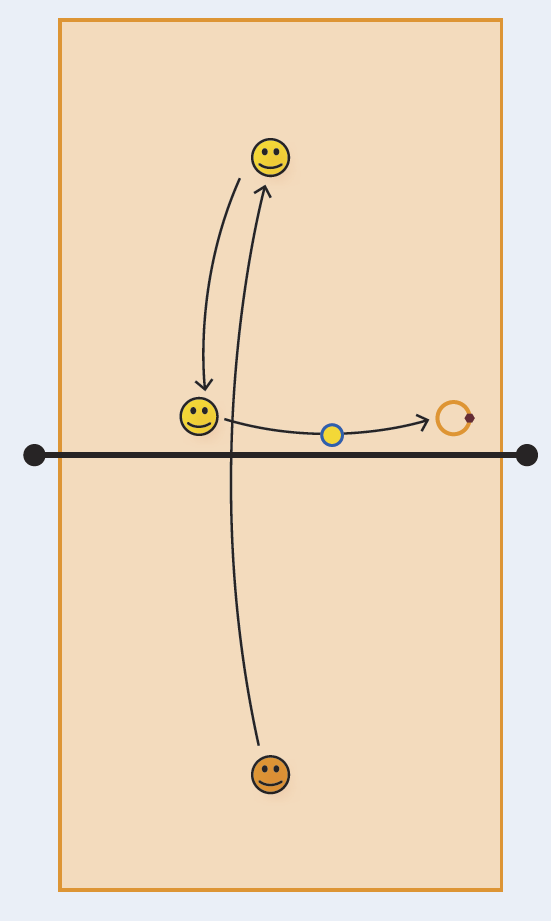
- 1 server, 1 passer, 1 playmaker, 1 finisher.
- Between the passer and the setter an inverted triangle can be visualized.
- The top of the triangle lies near the passer, the bottom against the net.
- Start the exercise with an easier serve.
- The pass should be sent to the corner of the triangle, which is the most middle of the court.
- The setter sets the ball to the other end.
- The distance between them is max 2 meters.
- To work more accurately a standing basket can be used.
- Continuation: Instead of a basket the coach plays the ball back to the passer, repeats and catches / plays out if necessary.
- With 3 players use 1 passer and 2 setters; coach serves.
- With 5 players you let 2 playmakers alternate.
- With 6 players divide the game in two groups and use both sides of the court.
- Work on the correct technique - turning in towards the post, before the set is given, helps with the execution.
- The set should be given in a dynamic movement in the attacker's shoulder line.
- The most common is to work with a standing leg (front leg) in a small lunge position with the legs initiating the set up.
Adjustments
- The service of the 1st ball can be very easy so that the passer can deliver a good pass every time.
- Increase the pass rush by making the service more difficult.
- Have the setter start from a deeper point in the court.
- Have the setter start from block position.
- Vary set goals; increase the distance to the goal or decrease the goal, shift the goal per set.
- Try to get 5 perfect passes and setups in a row.
- Involve the partner in the exercise by giving feedback, or by having the ball attacked without a jump.
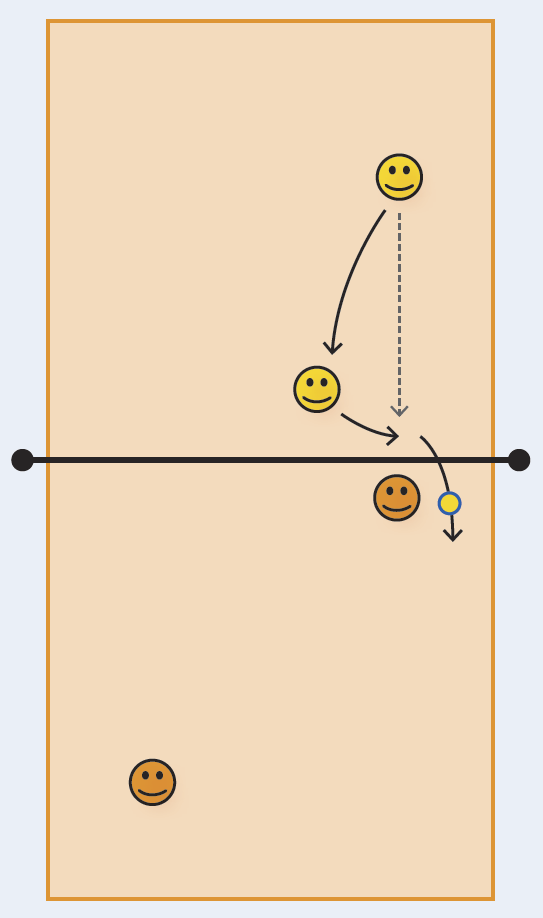
- Build an attack on one side;
- The blocker stands in front of the attacker, pretends to jump and steps back;
- The attacker plays a short ball over the blocker; the blocker defends the ball and the rally continues or the ball is scored.
- When the attacker gets in the middle, you can train both ways.
- The same when the attacker plays short diagonally
- The blocker makes a step into the diagonal, pretends to jump and then runs to defend the diagonal ball.
Variations:
- The first ball must be played short.
- Then play against each other for the point.
- Apply it in a situation where the attacker has no restrictions.
- Trainer (or one of the players) throws in the first ball from a table.
- The attacker may try to score the ball in the area just behind the net.
- Along the line or diagonally. With a defender added the