





Handballexercises for technique defense
Last update: january 2026
Objective
- Practising attack and defence in match situations with high tempo.
- Focus points for attack: A lot of movement, do not stay in one place.
- Focus points for defence: Who steps out and when.
- Defence is outnumbered and tries to break the attack by slowing down the pace.
- Defence is fully positioned with a pivot behind them.
- Focus points: Who has the pivot and when do they step out.
- Same as 4-against-4, but now first the left wing player (LW) and then the right wing player (RW) are involved.
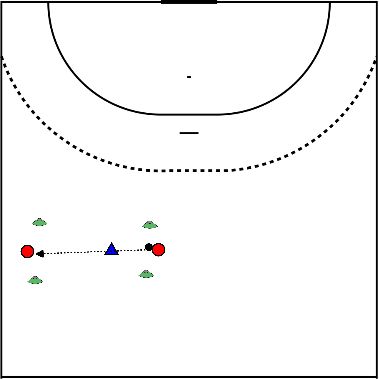
Preparation
- Make groups of 3
- Mark off space of 2 by 4 meters.
Exercise
- Player 1 has the ball and stands on one side of the 'field'.
- Goal is to give the ball to the 2nd player by running and turning with the ball around the defender (rugby style)
- The defender continues to defend the attacker frontally and gives counter pressure.
Coaching
- On the front foot, give pressure frontally and not through the side
Exercises:
- Exercise 1:
- 1 vs 1 without a goalkeeper in the goal so that shots can continue to be made in quick succession, when everyone has shot the balls pass and keep changing defenders. Then build up to 2 vs 2 and so on to 3 vs 3.
- Exercise 2:
- Around the center line practice footwork with the ladders.
- Exercise 3:
- Second line -> occupy the 3 buildup positions offensively and teach the second line. Starting on the left side, causing it to start up and come in, eventually ending up at the right build-up. the Middle and right build-ups both move up one position to the left. The ball passes through the left build-up to the right build-up, which then plays to the middle build-up who will finish.
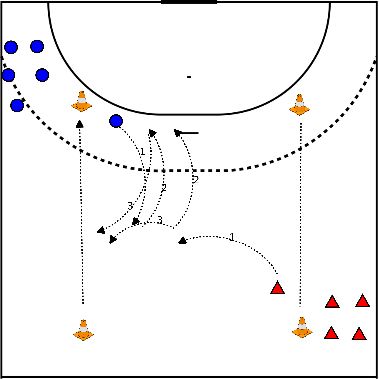
Preparatory practice and mental toughness training:
- Defenders in left or right corner, 1 active defender.
- Attacker starts to the middle between the pawns and then sprints to the circle.
- Defender anticipates.
- At the 3rd run, the attacker tries to pass between the pawns without being tapped.
- Continuous switching between attacker and defender, both left and right.
- Attention to anticipation, keeping distance, footwork, mental toughness so don't give up!
Explanation quick middle-out:
- Only 1 player with ball needs to be on the center line, the goalkeeper can already blow the whistle.
- 2 teams, 2 goalkeepers in 1 goal area, so 2 stations.
- 2 defenders - 2 attackers.
Version 1: quick middle-out
- Keeper gets shot at goal, how does the defending side then get the ball to the center line as fast as possible with the foot, before the opposing team has run across the center line.
Version 2: ball possession
- Goalkeeper gets grab ball. How does the defending side get the ball across the center line as quickly as possible while the opposing team is allowed to defend?
- Points of attention:
- Goalkeeper may run with ball in circle, and outside circle as field player -do not run with ball out of circle.
- Connectability field players.
1 goalkeeper - 1 defender(with vest) - 2 attackers
- In front of the goal, on the circle, an area of 4 meters is marked with hats. In between stands 1 defender. (preferably starting on the 9 meter)
- 2 players play towards the goal and try to outplay the defender. The defender tries to actively conquer the ball.
- After a shot on goal, or conquering the ball, the next duo approaches the goal
- After 3 to 4 rounds of play, the goalkeeper and defender must be switched.
Extension
- Allow the defender to make physical contact according to the rules. So do not clamp down, do not hold on to the arms, but do hold on to the front of the body
1 goalkeeper - 2 defenders (with cap) - 3 attackers
- In front of the goal, on the circle, an area of 6 meters is marked with hats. In between are 2 defenders. (preferably starting on the 9 meter)
- 3 Players play towards the goal and try to outplay the defender. The defenders try to actively conquer the ball.
- After a shot on goal, or conquering the ball, the next trio approaches the goal
- After 3 to 4 full rounds, goalkeeper and defender change places
- Lay down: 2 markers for the null pass, 3 markers for left right left - and that 2 times
- At the circle stand 2 (still passive) defenders.
- Attacker approaches them, throws the ball, defender throws it back so that the attacker can make a null pass, and execute the passing move: null pass - left, pass step to right, left to circle and shot.
- 1 station further, the movement is executed counterclockwise, with overpass and possible turn, or full turn.
- Pay attention to 'light feet'.
We play this to practice the previous exercises at high speed and in competition form.
- 3-vs-3 without circle. Point of attention in attack: lots of movement, don't hang on your spot. Point of attention in coverage: who steps out when.
- 3-vs-4 with circle. Cover is undermanned and tries to break the attack by taking the speed out of it.
- 4-vs-4. The coverage is now complete with a circle in their back. Again, focus on who has the circle at what time and when they should step out.
- 5-vs-5. Same as before only now first LH and then RH are involved.
- Players roll the ball
- Go after it
- Pick up the ball and dribble on
- Players roll the ball
- Go after it
- Run around the ball
- While facing the same way
- Then they pick up the ball and dribble on
- In pairs
- Trainer stands between the two
- Throws the ball away
- Players run after it
- Player who has the ball first becomes attacker, other defender
- Does the striker succeed in shooting at the goal?
All kinds of exercises with mats
- Pairs of 2 with 1 ball
- Player with ball tries to touch the mat with his foot
- Other player tries to prevent it with the body
- Defender has hands on his back
- Each pair 2 times 1 minute, then change.
- Both players are on their knees on the mat
- Try to push each other off the mat
- If someone is pushed off the mat, start again
- Both on knees on the mat
- 1 Holds ball, other player tries to take ball away
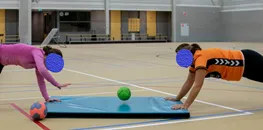
- The ball is on the mat
- Both players with their hands on the edge of the mat, roll the ball towards each other
- Repeat, but then after contact with the ball move forward a bit, so that you have gone all the way around the mat
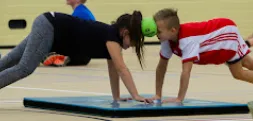
- Ball between the heads of the players, on hands all around the mat.
In this exercise, we're looking at how the coverage should be in a 6-0 variant, and who should be in touch when.
This is mainly a theoretical exercise, show the different situations in slow-motion. Points of attention are;
This is mainly a theoretical exercise, show the different situations in slow-motion. Points of attention are;
- Let the players think for themselves about what they have to do in different situations!
- Communication in (especially) the central block is important!
- Corners should not be too offensive, unless they actually have the ball
Questions you can ask your players;
- What happens when the circle runner changes position?
- What happens when a corner passes?
- What happens when the opponent plays a rehearsed attack?
- When do you as left back court or right back court have to help?
- When do you as left back court or right back court have to step out?
- How far should you step out?
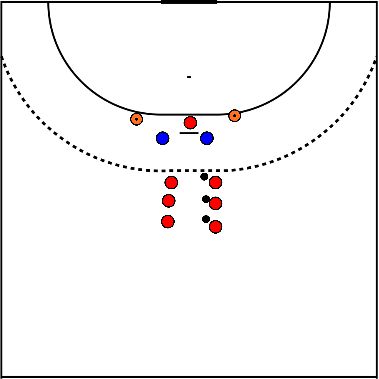
- An attack is played between 3 attackers and 2 defenders.
- The attack is played on a slightly wider field than the posts (about 6 meters)
- The goal of the attackers is to complete the attack, this can be done via an action or via the circle.
- The goal of the defenders is to prevent the attackers from finishing.
- The attackers play the ball quickly from left to right and try to provoke the defenders.
- If a defender steps, they can lay the ball off to the circle,
- If a defender doesn't step, they can play over or make their own move past the defender
- When a defender steps out, the second defender must step into the circle, the defence moves with the attack.
- If an attacker makes a move past the defender, the defender must try to get the attacker out of the 'zone' (the hats).
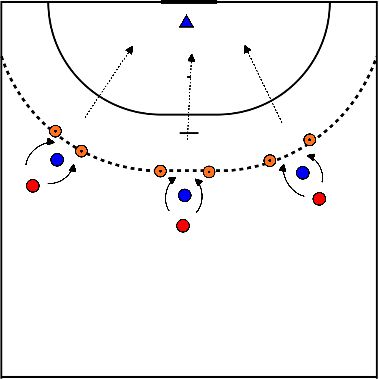
- 2 pairs.
- One (defensive) player on the dotted line.
- Other (attacking) player in front of them.
- The offensive player tries to pass the defensive player between the pawns (without ball).
- One (defensive) player on the dotted line.
- Other (offensive) player in front.
- The attacking player tries to pass the defending player between the pawns (with ball).
- Possible shot on goal.
- Attackers:
- Quick movement.
- Continue shot attempt even though someone is hanging on to you.
- Defenders:
- Keep attacking player in front of you.
- Grasping at upper arms.
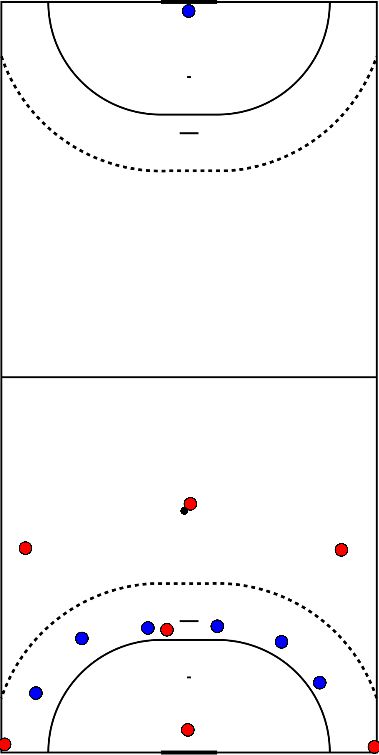
- A normal game is played, however with a special rule.
- Everything remains the same, teams of 7 (6 field players + 1 goalkeeper) are made.
- As a team in a break-out.
- In a first or in a second phase they make a goal they may attack again.
- If they have scored in this way they may break out again at the centre builder.
- If a goal is scored in this attack, they have made 2 points in 1 attack.
- If they don't score, it's only 1 point.
- This continues until time is up.
- Change:
- You can also choose to reward a break-out.
- You can also choose to reward a break-out, first or second phase attack with 2 points instead of a new attack.
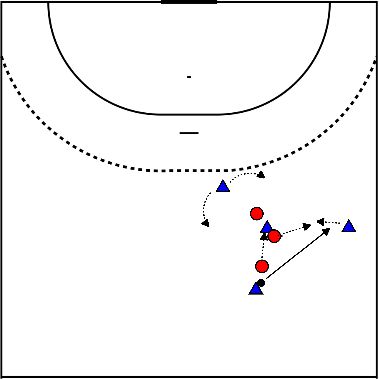
- 4 attackers.
- 3 defenders.
- 1 attacker stands like a circle in the middle.
- 3 defenders stand around it.
- The other attackers try to play the ball around by applying pressure.
- The attacker in the middle.
- Defenders try to intercept and prevent the attacker in the middle from receiving the ball.
- Attention defenders:
- Talking.
- Stepping out.
- Step back.
- Good foot forward.
- Blocking space with arms.
- Cover your back.
- See Insta-film.
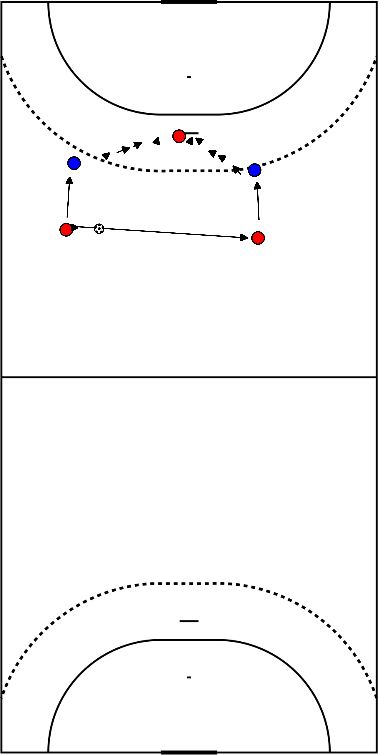
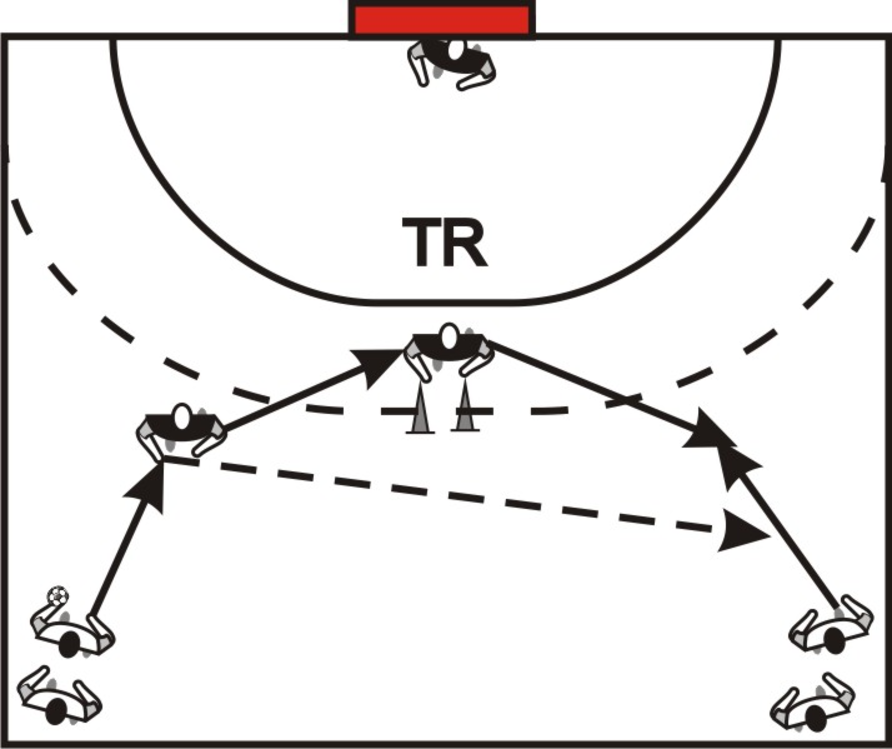
- 2 Builders play the ball to each other at a steady pace, each time making a forward threat.
- The defender performs a correct defensive stance.
- Stepping out / inserting Runner sideways
- Variation:
- The trainer gives an optical signal after which the attacker comes 1 against 1 followed by a completion on goal.
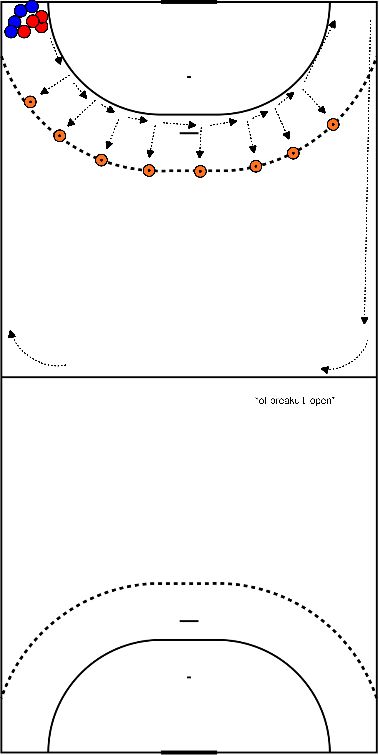
- first round only move from the right to the left side - sprint to the middle line and connect
- second round, move over the circle and get out at the 9m or put down pawns
- third round two teams face each other 6m + 9m, both move and player at the 6m steps out at the pawns and makes contact with the player at the 9m (can be done with or without ball)
- fourth round turn the third round
- then repeat everything from the other side!
- EXIT as breakout!
- player is going to slide/step out first and break after that
- goalkeeper plays on / goalkeeper has to practise first
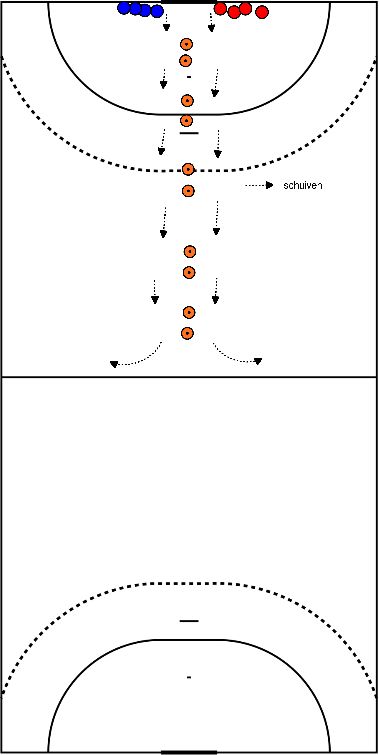
- Pairs face each other / width of the goal / so right and left of the goal
- both players move to the first pawn and then make contact for 3sec (hands against the shoulder, defensive exercise) then move on to the next pawns and repeat
- Move to the first cones, jump at the same time and give each other high five.
- Repeat this exercise a few times!
- all behind the backline - sprint 60% to half of 1 half then 100% sprint to the middle line / repeat this a few times / with different starting phases e.g. tripping on the foot, sprinting away from the boards, facing the wall ......

- 6 pawns / 2 x 2 pawns about 5 to 6 m apart at the height of 11 to 12m / 2 pawns at the height of 7m to demarcate the field / see image
- players divide into 2 teams / 1 team wears shirts
- 1 point of play on the center line with all balls
- players stand behind a pawn diagonally from each other.
- first player with and without vests start sprinting at the same time from 1 to the other pawn and pass the pawn and sprint again.
- after the 2nd sprint, 1 player receives the ball and goes 1:1 against the other player
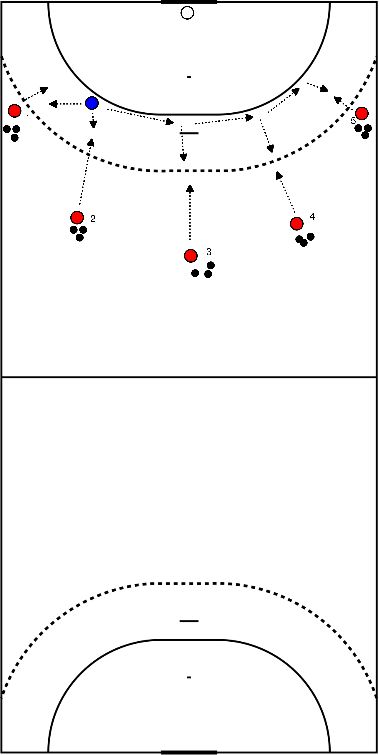
DESCRIPTION
Attackers have a ball.
- 5 plays to 4 to pass defender 1.
- 4 plays to 5 that passes the defender.
- 3 plays to 2 to pass the defender.
- 4 plays to 3 that passes the defender.
- 2 plays to 1 passing the defender.
- Defender 1 tries to prevent all players from passing him and defends with making contact.
- Each defender twice in a row, i.e. 10 actions in full.
COACHING POINTS
defending the player in possession with contact
- arms bent forward
- blocking the way
- don't let your opponent run in between your arms
- push the attacker outwards
- counterpressure against shoulder that is inwards
- guide movements
- footwork very important, one must be able to keep up with the attacker
- keep contact with floor
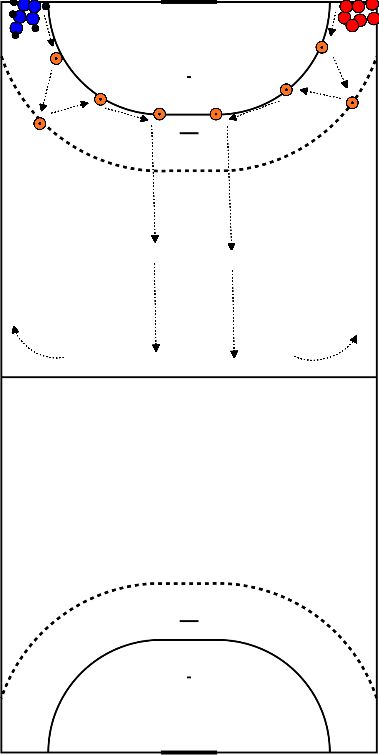
- create pairs and divide them on the left and right corners
- each pair has 1 ball
- a pair of them start sliding at the same time from the 6m to the 1st pilon,
- then move out to the pilon at the 9m and move to the third pilon
- then sprint to the centre line at the same time to pass the ball back and forth
- join the line in the other corner
- Variations: On speed and the player without ball becomes defender and tries to conquer the ball