



Basketballexercises for u20
- Stand on one leg, raise the other as high as possible.
- Ball with 2 hands above head.
- Found balance trying to close eyes.
- Then the other leg.
- Stand on one leg, stretching the other as far back as possible.
- Ball in front of you to 15cm above ground, then up again.
- Drop 45gr to your left to 15cm above ground, then right.
- Found your balance and close your eyes.
- Then the other leg.
- Stretched lunge position with arms spread
- Close your eyes and slowly move the ball from left to right.
- Then other supporting leg in front.
- The ball is held at the side with relaxed and spread fingers.
- the palms of the hands must not touch the ball.
- The thumbs are behind the ball;
- the thumbs are behind the ball, and imaginary lines are drawn along the length of the thumbs,
- Then they must cross in the 'heart' of the ball. .
- the elbows are bent beside the body; the points are pointing to the ground.
- the ball is held in front of the diaphragm.
- in the face of an aggressive defender, the ball is brought up over the head or towards the hip;
- in the latter case, one foot is placed in the direction of the opponent;
- the elbows are slightly spread.
- Halfway through the normal dribbling height, the ball is brought to the other dribbling hand with a wrist strike via a flat bounce.
- At the moment the movement is started, the right leg steps forward,
- so that the ball can reach the left hand unimpeded.
- The ball passes in front of the left foot.
- The ball is taken low with the other hand.
- After the takeover the body turns over the left foot between the ball and the defender,
- where the free (bent) arm again has a protective function.
- In the speed dribble, the upper body makes an angle of less than 90 degrees with the ground.
- This is highly dependent on the speed at which the dribble is performed. The higher the speed, the smaller the angle.
- The dribbling arm is directed more forward due to the speed.
- The dribble is between hip and chest height; the ball is pushed powerfully to the ground and lands next to the shoulder axis in front of the feet.
- If there are no defenders around, the free arm has a balancing function
- If this is not the case, the dribbler will initially try to increase his speed in order to shake off the defender
- If this does not work, he can use his free arm to prevent the opponent from taking the ball.
- Obviously, this will be at the expense of speed.
- The walking speed must be in accordance with the dribbler's level; walking and dribbling must not hinder each other.
- The knees and ankles are bent strongly during the low dribble, allowing the ball to stay extra low to the ground.
- The torso and head, on the other hand, remain practically straight.
- The gaze is directed towards the opponent(s) and the rest of the field of play
- The free (slightly bent) arm is turned towards the opponent and has a protective function.
- If the situation requires, the body is brought between the opponent and the ball.

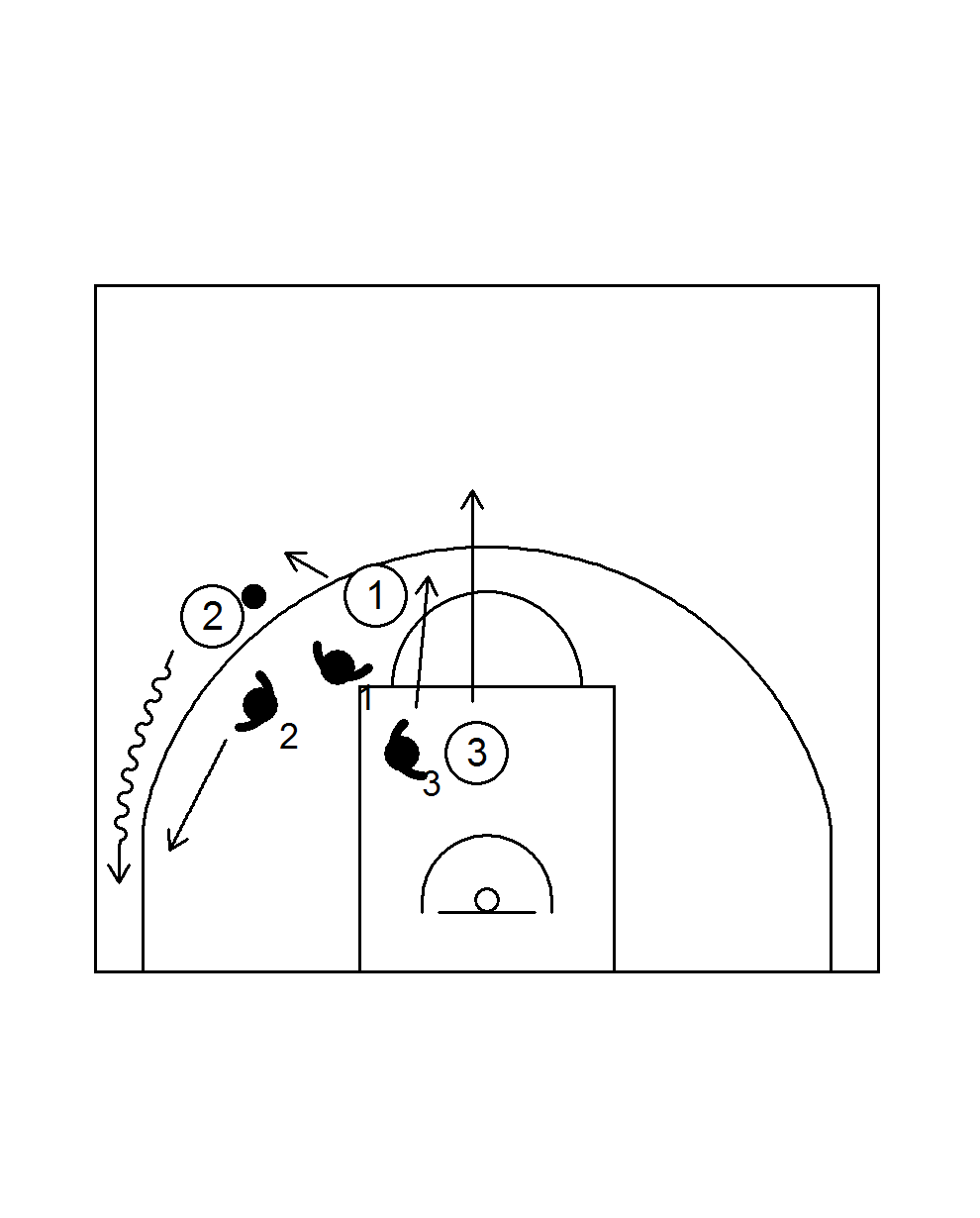
Goal: to defend one pass away
Organization:
- attackers use quarter of the field
- try to get free with in-out or cut
- first restore balance by occupying the 3 positions before cutting again
- defender overplays when his man is playable with one pass
- attacker can dribble
- a waiting player counts down 20 seconds
Teaching Points:
- hand in the passing line
- front foot in the passing line
- catch your man with your forearm
- 3/4 of your attention on the man, 1/4 on the ball
- NO help
- change after x stops
Form of play:
- each team gets 5x ball possession
- who makes the most stops
Requirements:
players must be able to play individually 1 against 1
Goal: train position of the defender to help prevent penetration (instead of passing over) + recovery
Preparation:
- the defender must first choose his position in such a way that he can help stop the penetration
- after matching the attacker, he takes up his position between the ball and the ring
- at the distance suited to the qualities of the attacker
- or at the distance requested by the coach
- the players play 1 against 1
- Attacker becomes defender.
- New attacker turns in
Organisation:
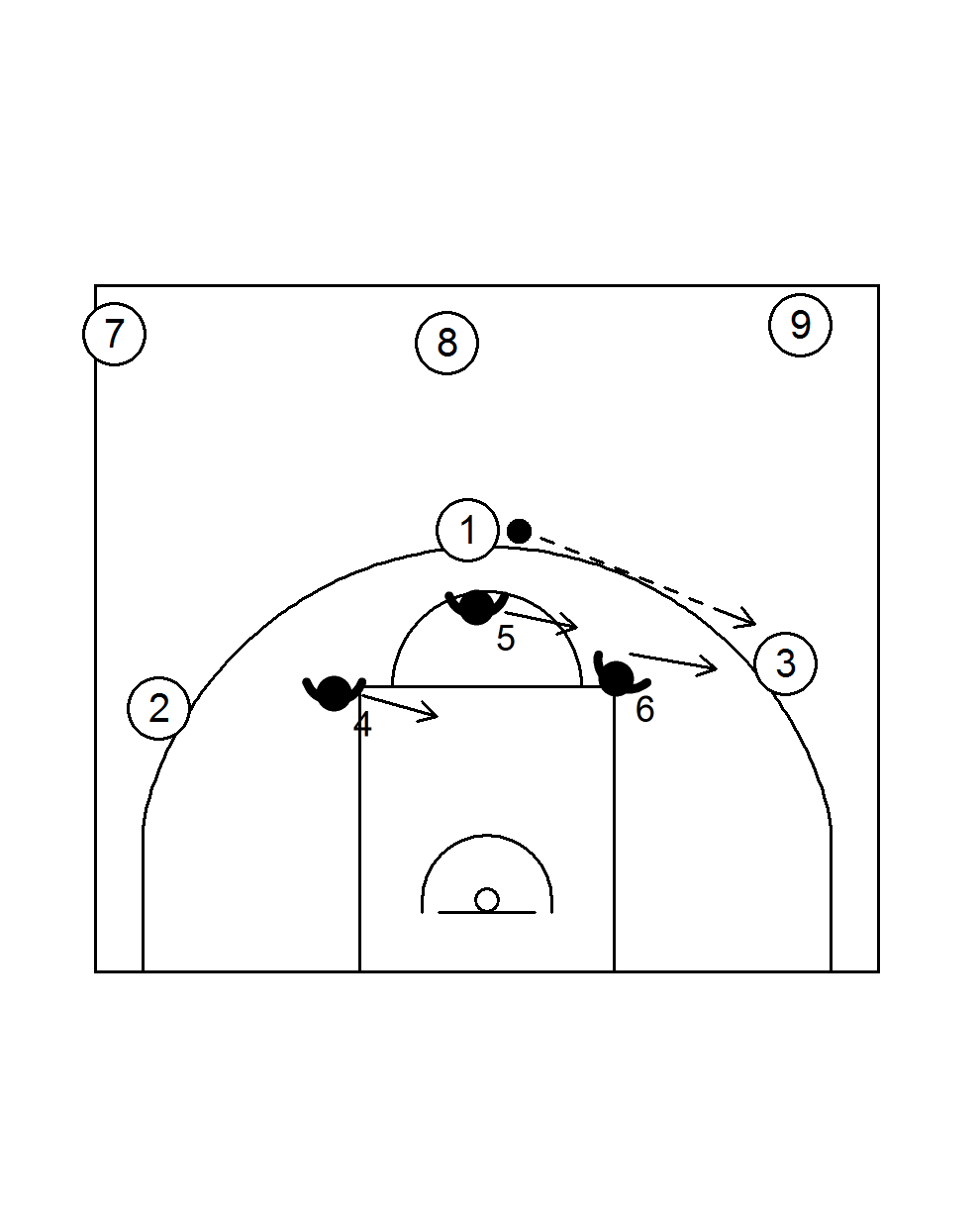
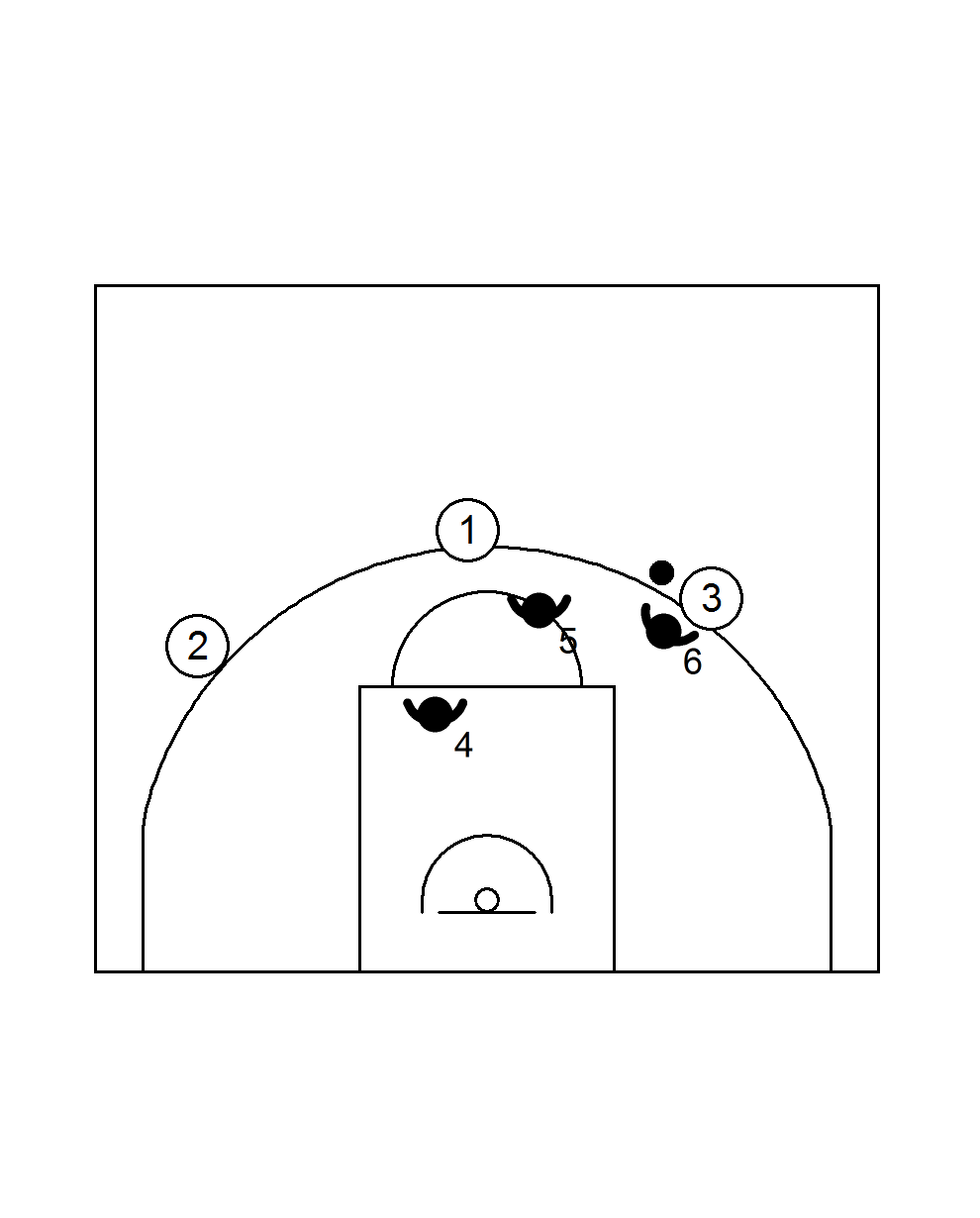
- the three defenders start in the bucket, with the ball
- defender 5 rolls the ball to 1 and defenders take up their positions
- attackers hold their position and pass the ball back and forth (also pass fakes!!)
- they may score with a drive or a dribble with jump shot
- a three-point is a point for the attack
- a two-point shot is a point for the offense, but
- if there is still a defender between the shooter and the basket at the moment of shooting, it is a point for the defense
- interception or defensive rebound is a point for the defense
- play until the 5, then change
Teaching Points:
- defenders have to take the right position immediately after the pass with an explosive step
- Anticipate the pass and take a slide step so that you can get to your defensive position earlier (in case of a pass fake, you have to take a slide step back quickly)
- one pass away = one metre from your man and one metre from the passing line, so that you can help with the penetration of the ball
- when the ball is 2 passes away, you have to stand with 2 feet in the bucket
- immediately after the shot, both defenders must look at their man instead of the ball and box out
Variations:
- offensive rebound is a point for the attack (if you want to emphasize boxing out)
- shallow cut from 1 after the pass + 2 rotates to the head
- shallow cut from 1 after the pass + 2 sets a screen for 1 under the elbow and then steps out to the guard position
Requirements:
players must be able to play individually 1 against 1
Goal1: Improve the position change of the defender between helpside and ballside defense
Goal2: boxing out after the shot
Organisation:
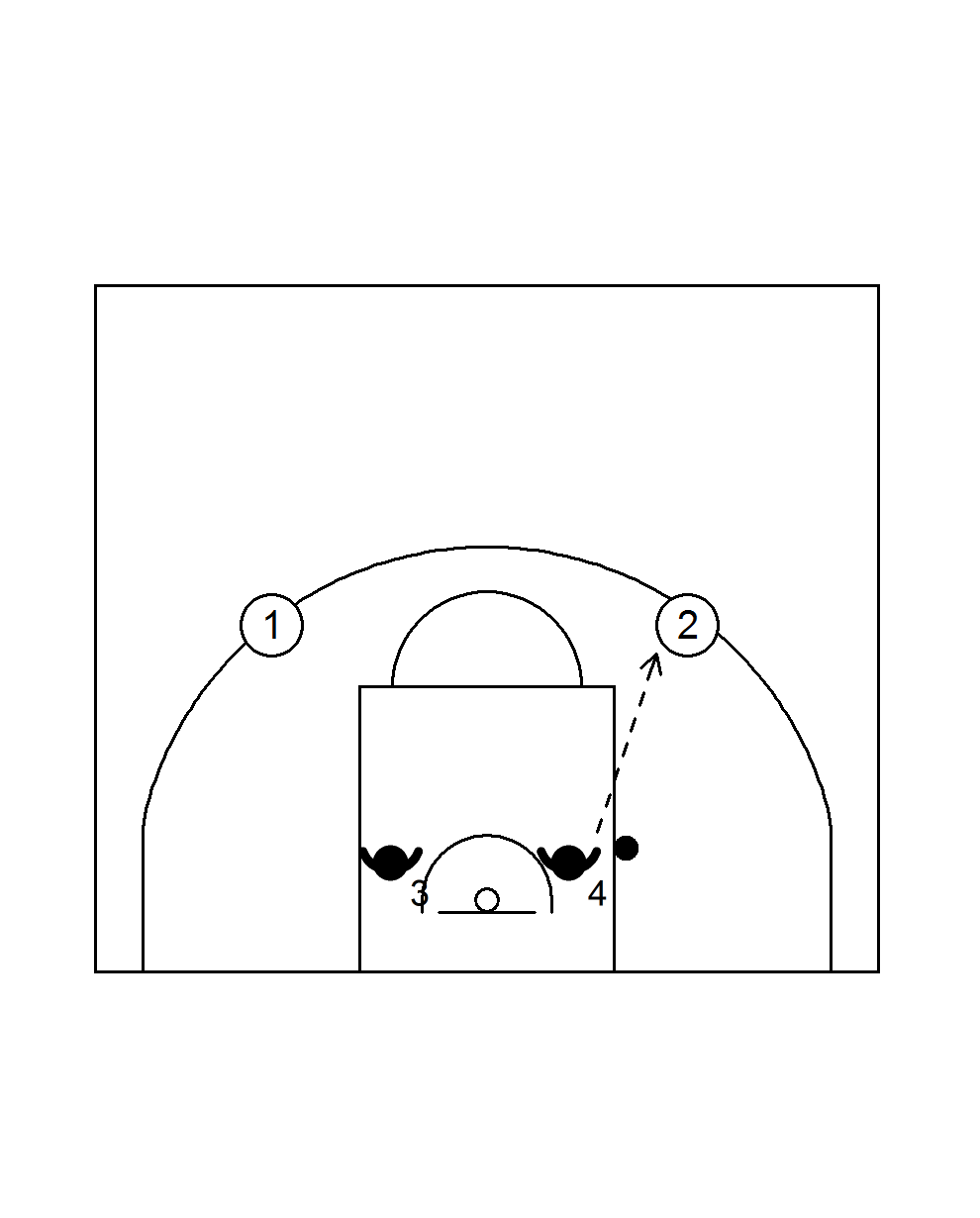
- one of the defenders passes the ball from under the basket to an attacker
- A defender on the ball side closes the way to the basket (close out).
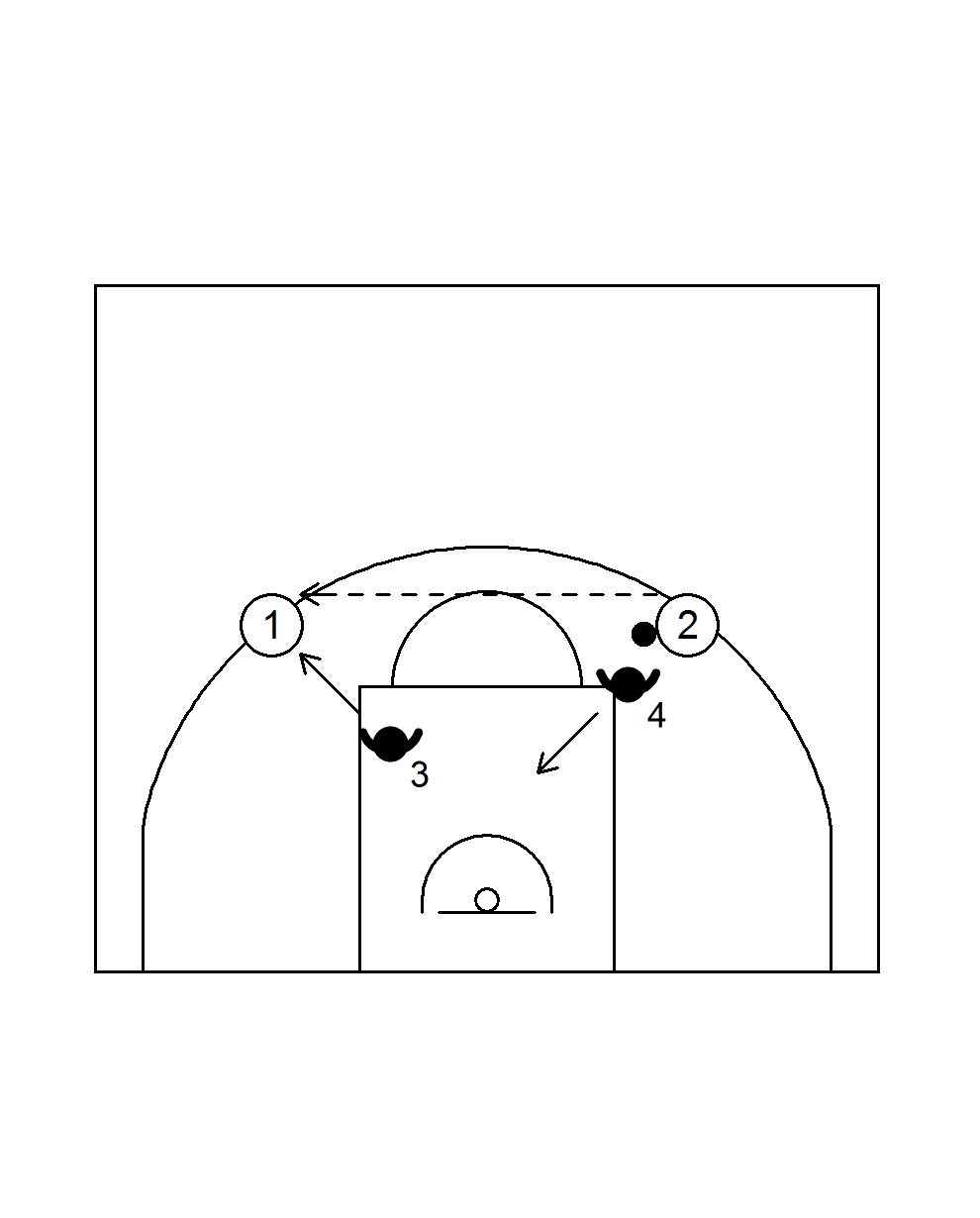
- the other defender takes the help side position: one foot in the bucket if the ball is above the free throw line; on the basket-basket line if the ball is below the free throw line
- When the ball is passed to the weak side, both defenders must quickly adjust their position relative to their man.
Substitutions:
- make it, take it
- or two is too much (push up defenders after 2 consecutive scores)
- (if you have more than 4 players, let the other players practice shooting at the other basket)
Teaching Points:
- Close out weak side shooter
- two explosive sprint steps, then lower your hips a bit + reduce step size
- inside foot in front
- outside hand in the shooter's face
- After the shot:
- immediately after the shot, both defenders must look at their man instead of the ball and box out
- put the forearm on the chest of the attacker
- box out with a front pivot or a reverse pivot and chase the ball
Variations:
- defenders may score from a rebound or interception
- the scoring team continues to attack
- play until the 7
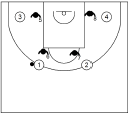
Prerequisites:
players must be quite proficient and in good shape
Objective:
concentration and energy in defense
Organization:
- 4 against 4 on one basket
- new defenders when the defence has made 3 stops (i.e. the defenders gain possession of the ball).
- after a score or a foul on the shot, the defending team returns one stop
- The exercise lasts 12 minutes
- and if you do not defend well, you are defending for 12 minutes.
- if the attacks take too long, the trainer will count down loudly: 5-4-3-2-1-0
Teaching Points:
- After 2 stops the whole defense steps up their game. When they make the third stop, they can start attacking.
- As a side effect, the attackers learn in a playful way who will hit the balls when it gets exciting, and who will not.
When you have 12 men:
- rotate with 4 men
- After every stop, score or foul on the shot, a new team of attackers enters the field (trainer determines if it is a foul).
- the team that causes the third and last stop goes to defend
Variations:
- three defenders, four attackers
- make 2 or 3 consecutive stops before being allowed to change.
- (with shot clock) 35 seconds of defense without scoring and without a foul. At a stop, the clock stays on and the attackers can try again. If the attackers score, or grab an offensive rebound, or if the defense makes a foul, the clock goes back to 35 seconds.
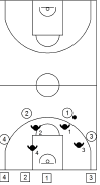
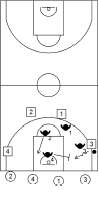
Prerequisites:
players must know how to apply help side and ball side defense
Goal: to learn each defense system
Organization:
- a team can get a point with a defensive stop, with a score from a fast break or with a three-pointer from the secundary break
- (stopping the break by capturing the ball counts as a defensive stop)
- winner is the team that earns the last point OR, if no one earns a point, the team that scores
- the winner may always go and defend
- new attackers enter the field
Teaching Points:
all aspects of team defense
Tips:
- defending the break is also part of this exercise. That is why the three-pointer from the secondary break is also a point. This forces all players to defend after losing the ball in the attack.
- If the break is not executed quickly, blow it off. This will improve the speed at which the players react.
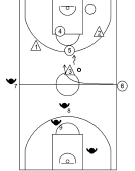
Note: The illustration shows the situation after a score from a break. The defenders first made a stop and then scored from the (secundary) break. So, two points. They therefore continue to defend and new attackers have entered the field
Prerequisites:
players must know what a double team is
Goal:
- to train double teaming
- dynamic organizing and reorganizing of the defense
- practice transition
Organization:
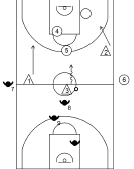
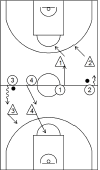
- 3 players attack along the length of the whole field
- 3 attackers start at the half way line
- 3 defenders per half
- of both defending teams one player takes up position near the half way line
- defender 6 waits near the halfway line
- can only start defending when the ball is in the attacking half
- must sprint with both feet through the centre circle before joining the defence
- from that moment on, two defenders must always try to double team the man with the ball
Rotation after scoring:
- the defender closest to the half way line immediately takes up his position next to the pitch
- attackers must take the ball from the back line
- the three remaining defenders try to prevent this (5 seconds)
- if that does not work, they have to try to trap the dribbler with a double team
- if the defenders capture the ball, they immediately attack the same basket again (like in a Full Court Press in a game)
- the fourth defender joins the defense (i.e. the other three) immediately after the turnover
Rotation after the turnover:
- the player with the ball in his hands hands hands it off to another player and takes up his position near the center line.
- the three remaining players attack the other basket
- the team that has lost the ball defends.
Teaching Points:
defenders always try to conquer the ball with a double team.
Variation:
can also be played 3 against 3 + 1 half court: after a score the attackers have to take the ball and get it over the half court 1
Prerequisites:
players must know what help side defense and what ball side defense is
Goal: train early help and quick recovery
Organisation:
- the three defenders stand facing the back line and take up their defensive positions as soon as the coach passes
- coach passes the ball to a random attacker
- the attackers have 10 seconds to score and the coach counts down aloud
- play until the 3 stops or a difference of 2 (stops scores), then change
- screens on the ball are not allowed
Teaching Points:
- defenders must move when the ball is in the air
- occupy the agreed-upon helper position
- stop the penetration when the man with the ball passes his defender
- anticipate the swing pass: take the first step towards your own man even before or as soon as the passer picks up the ball
- Communication as agreed within the team
Variations:
attackers are only allowed to score from the bucket.
Variation with more competition element:
- attacker with ball starts at 2 meter of the three-point-line; place to be determined by the team.
- must start with a dribble
- the defenders may turn around at the first dribble
- the attackers must make a goal attempt within 20 seconds - the waiting players count down
- you can only earn points in defense
- two stops in a row are one point
- if you score twice in a row, you may go on defense
- Losers turn out
- new attackers turn in
- play until the 3
Requirements:
- players must individually be able to defend the man with the ball
- players must know how to defend the man without the ball
Goal: To apply individual defensive technique in a simplified game situation
Organization:
- attackers use a quarter of the playing field
- are not allowed to cross the lifeline
- play 2 against 2
- winners will attack on the other half of the field
- losers keep on defending on this quarter (when there are more than 8 players, turn in at the halfway line)
Teaching Points:
- emphasise what you have taught the players individually
- there is no help (this makes it clear who is not defending well).
Variations:
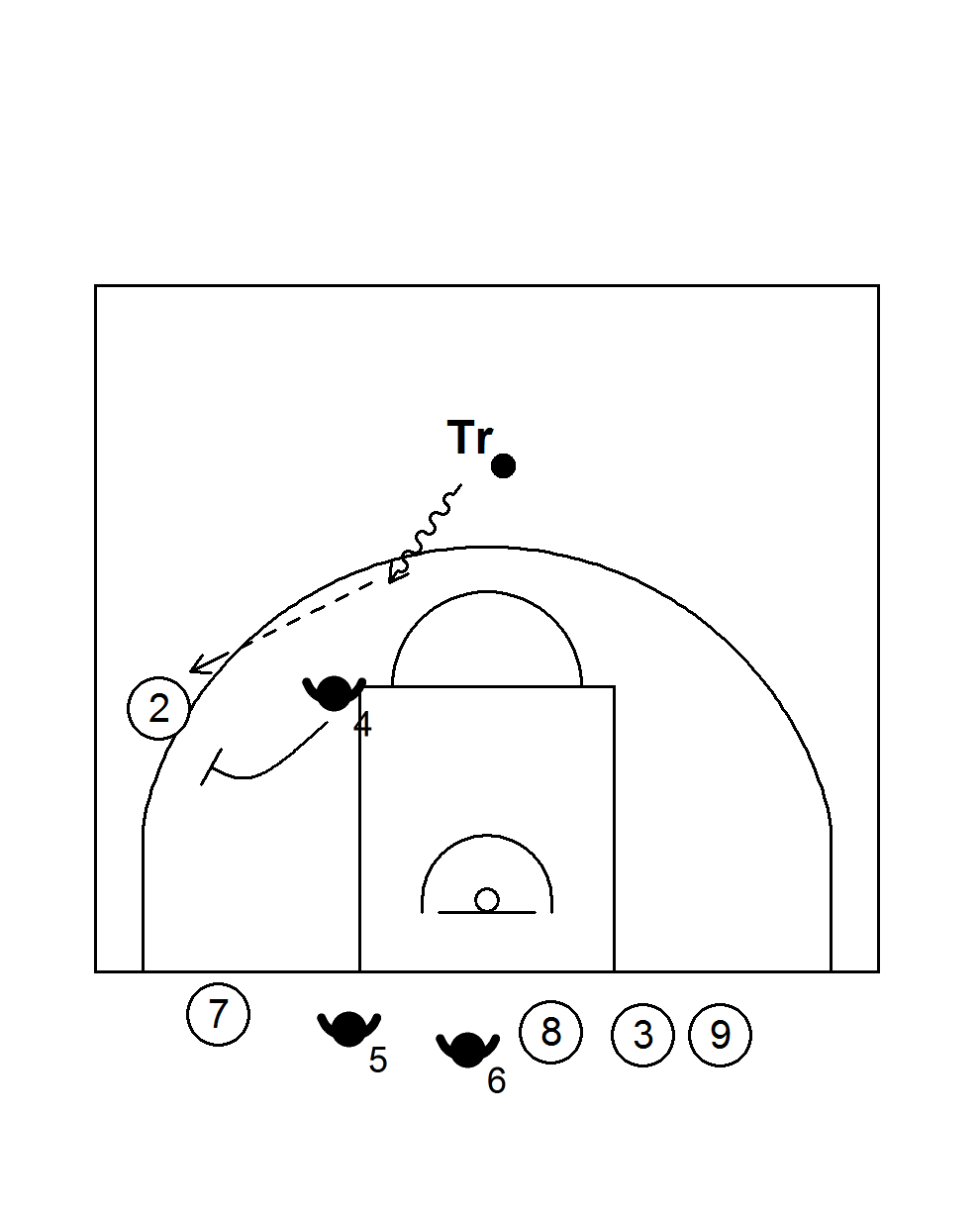
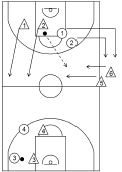
- let the defender keep their hands behind their back if you want to emphasise footwork In the picture:
- Defenders 1 and 2 have conquered the ball without allowing attackers 1 and 2 to score
- defenders 1 and 2 attack on the other half of the pitch
- 5 and 6 will enter as defenders and play against the winners of 3 and 4
- former attackers 1 and 2 wait for their turn to defend
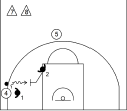
Prerequisites:
players must know what help side defense and what ball side defense is
Goal: train early help and quick recovery
Organization:
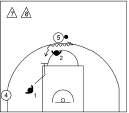
- attacker 5 threatens with a drive outside, changes hands and attacks the elbow
- defender 1 starts with a foot in the bucket and needs to help early
- on the pass to the corner, defender 1 must recover his position with a sprint and close out
- defender 2 must drop far enough to stop a drive from 4
- the attackers must make a goal attempt within 20 sec - the waiting players count down
- you can only earn points in defence
- two stops in a row are one point
- if you score twice in a row, you may go on defense
- Losers turn out
- new attackers turn in
- play until the 3
Teaching Points:
- defenders must move when the ball is in the air
- the helper position is such that you can stop the penetration when the man with the ball passes his defender
- Anticipate the pass: take the first step towards your own man as soon as the dribbler picks up the ball
- Communication as agreed within the team
- close out = 2 sprint steps followed by minislides + lower hips + 1 hand up
- the helper position is below the line ball - you - man + chest parallel
Prerequisites:
players must be quite proficient and in good physical condition
Organization:
after one team has scored 2 times the defenders go out of the field the winners get the ball
Ends when one team has won 5 times.
Losers have to work very hard physically afterwards. They should know this in advance so they will do their utmost to not lose.
If the MTM is not intense enough then the coach will award a score to the offensive side
Losers: (= minute drill: 45 sec full, 15 sec rest)
For each point difference in the score:
- 4 sprints back and forth across the field
- Push-ups until signal of the trainer
- 15 sec rest (players who lost by 1 point difference are finished)
- 4 sprints + sit ups until signal of the trainer
- 15 sec rest (players who lost by 2 points are finished)
- etc
If you are with 8 players:
- the two players who turn in ask one of the players who got out to join them
- players then count individually the number of times won
The players dribble one by one in a zigzag fashion along the length of the playing field. When a player changes direction he/she bounces the ball under the legs and also changes hands.
The players practice the crossover technique. They start dribbling with their strong hand. Then the ball is bounced in a V-shape to the other hand. Make this exercise more difficult by running with the ball or a track.
The players try to dribble the ball behind their back. This works the same way as the crossover technique except the ball is not passed in front of the body but behind the back.
Player 1 dribbles across the width of the field, player 2 tries to tap the ball away. When this succeeds, the roles are reversed. Players are allowed to use several dribbling techniques.
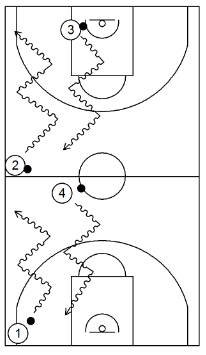
Requirements:
Players must be able to dribble away from the ball at an angle with one hand at the side
Preparatory exercises:
- with one, passing the ball in front of the body with a flat bounce from left to right
- Same with two hands, bringing the ball with the left hand from right to left and vice versa (so that the player is forced to bring the hand over the ball and exert force on the side instead of the top of the ball)
Objective:
practise speed and direction change with the ball behind the body and a 180 degree turn of the body
Organisation:
- players dribble zigzagging between two lines along the length of the field
- when they reach a longitudinal line, they make a spin dribble
- change direction and accelerate
- when the first dribbler reaches the extended free throw line, the next one starts
Teaching points:
- look over the ball and survey the court in front of you
- Stop in 2 TR
- Leg on the side of the ball is behind
- Hand over the ball
- First turn your head, then your trunk and then the ball
- Turn the trunk quickly
- back foot makes a turn of about 270 degrees
Variations:
Start left and right
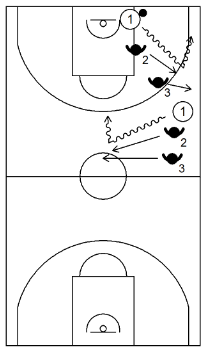
Prerequisites:
players must already have good dribbling skills
Objective:
practice retreat dribble to get out of a kick
Organization:
- use the length of the field
- defender 2 forces attacker 1 to the sideline with slides
- defender 3 sets up the kick by closing off the sideline
- dribbler creates space with a retreat dribble
- dribbles between the legs
- and attacks the free shoulder of 2
Teaching points:
- put the body between the 2 defenders and the ball
- Feet perpendicular to the direction of movement
- Take off hard and make a jump to the back
Variations:
- AFTER retreat dribble with between the legs OR under the buttocks by changing hands
- if you cross the centre line without the ball being tapped away by a defender, you play 1 on 2 on the other basket
- OR if you only have a quarter court: from the midline back 1v1 on the basket you left.
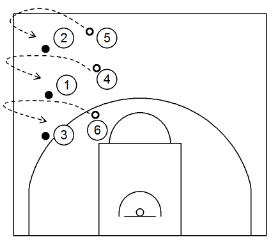
Prerequisites:
Players should have a reasonable grasp of the basic technique of dribbling.
Objective:
players practice surveying the surroundings while dribbling
Organization:
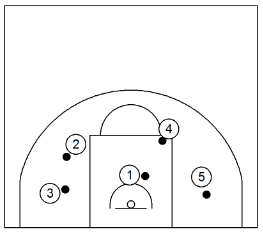
- players 1, 2 and 3 stand about two metres away from a wall they dribble with their weak hand
- players 3, 4 and 5 throw a tennisball against the wall in such a way that it bounces in front of the strong hand of the dribbler
- the dribbler grabs it and throws the tennisball over his shoulder to his buddy
- change after one or two minutes
Teaching points:
dribble with strength from the wrist
Prerequisites:
Players should have a reasonable grasp of the basic technique of dribbling.
Objective:
To have players dribble by feel while having their attention focused on something else
Organization
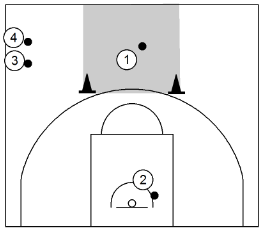
- each player puts a ribbon in his pants as a tail
- dribble inside the three-points area
- take the tail of another player and hang it around your neck.
- the game is over when there is no player left with a tail
Variations:
dribble with the weak hand only
Prerequisites:
players must already have good dribbling skills
Objective:
to train the ability to oversee the field while dribbling
Organisation:
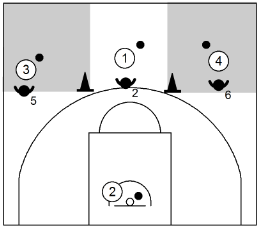
- pawns to mark the dribbling area
- player 2 is doing the Mikan drill
- the dribbler has to count the number of scores out loud and at the same time apply his dribbling skills
- (waiting players can practice their dribbling skills along the sidelines)
Teaching points:
- knees bent
- keep the ball low
- nose points to the ring
- always overlook the field, so no reverse on spin dribble
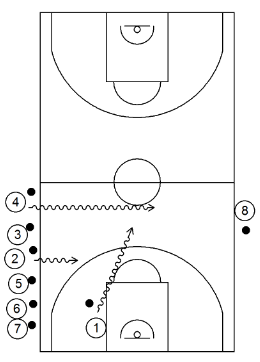
With defender:
- add active defender
- use several areas if necessary
With passes:
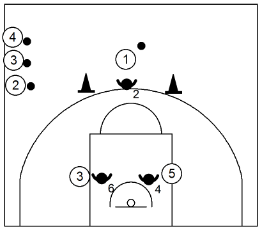
- defender 2 gives maximum pressure on the ball
- forwards 3 and 5 try to get free in turns
- 4 defends actively
- If the pass does not reach the forward in time, he/she steps back to the bucket edge.
- in case of a successful pass the forward plays 1 against 1 against 4
Rotation:
- defender 4 picks up the rebound and joins the back of the line
- the forward who just attacked becomes defender
- defender 2 becomes forward at the open position
- 1 starts defending the new dribbler
With extra defender:
- add extra defender, so there is less time for the dribbler to make the pass
- (players at the helpside are inactive)
- back through pass is allowed
Prerequisites:
Players must master the basic technique of dribbling.
Objective:
to improve the dribble with the pocketed hand
Organization:
- use half the field
- players are only allowed to dribble with their weak hand
- players are not allowed to pick up the ball
- start with one ticker
- the player who is tagged becomes a tagger and so on until there are only taggers left.
Teaching points:
- look over the ball and oversee the field in front of you
- bounce is hard
Variations:
- take the ball outside the field with two hands, but then start with two hard bounces before going over.
Requirements:
Players must be able to dribble away from the ball diagonally with one hand at the side
Preparatory exercise:
Dribble the ball from the left hand to the right hand with a flat bounce while standing behind the back
Goal
: practice changing speed and direction with the ball behind the body, while keeping the dribbler's field of vision on the part of the field in front of him
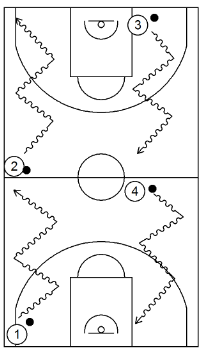
Organisation:
- players dribble zigzagging between two lines along the length of the field
- when reaching a longitudinal line, make a mini jump stop and behind the back dribble
- change of direction and acceleration
- when the first dribbler is at the extended free throw line, the next one starts
Teaching points:
- look over the ball and survey the court in front of you
- after the mini jump stop, feet side by side at shoulder width
- Hand over the ball
- Pass the ball with a flat bounce behind your back to the other hand
- Change direction with a crossover step
Variations:
- start left and right
Requirements:
players must be able to dribble with two balls at once
Objective:
To allow players to maintain control of the ball against physical resistance
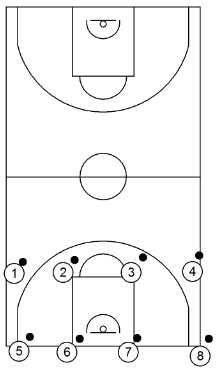
Organization:
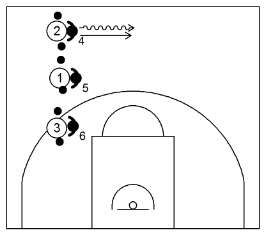
- defender keeps his hands on the shoulders of the dribbler
- he moves backwards along with the dribbler, but gives some resistance
- across the width of the field, change at the sideline
- equal or uneven dribbling
- possibly a ladies ball in one hand and a men's ball in the other.
Teaching points:
- Dribble with power from the wrist.
Prerequisites:
Players should have a reasonable grasp of the basic technique of dribbling.
Objective:
to practice changing speed without changing direction
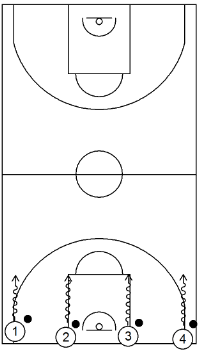
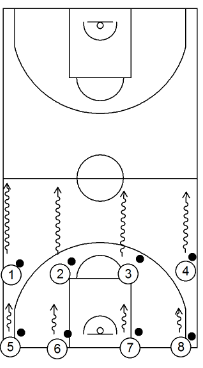
Organisation:
- players dribble to a line
- then make at least 2 dribbles on the spot
- and accelerate
- when the dribblers are at the free throw line, the next group starts
- at the free throw line, make at least 2 dribbles on the spot
- when the first group is past the free throw line, the next group starts
- at the end of the court turn around and on the way back 3 hesitations again
- players have to make sure that they don't bump into each other.
Teaching points:
- look over the ball and survey the field in front of you
- Keep the ball low during hesitations
- Hand behind the ball when accelerating
Variations:
- left and right hand
- Dribble with 2 balls
- Use dribbling goggles
Prerequisites:
master players crossover and behind the back
Objective:
to increase the speed of changing hands
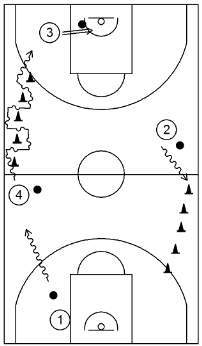
Organization:
- Place 5 pawns in a straight line from three-point line crossing extended free throw line towards crossing sideline and center line. The pawns are placed less than 1 metre apart.
- players zigzag with a low crossover between the cones
- finish with lay up
- jump shot
- push off jump shot
- push off lay up
Teaching points:
- look over the ball and survey the field in front of you
- Leg on the side of the ball is in front
- Hand over the ball
- Crossover dribble is backwards in front of the body and low
- with an open step in the other direction
- always make a dribble in between
- The ball is low
- Bounce is flat and hard
Variations:
- start left and right
- Behind the back in position
- Pawns on the defensive half and a defender on the offensive half, directly over the halfway line. Pass the defender with one of the practised moves
Prerequisites:
Players must master the basic technique of dribbling.
Objective:
to improve the different dribbling techniques
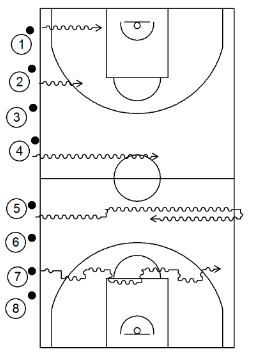
Organisation:
- Players dribble back and forth across the field twice and then get a new assignment.
- and then get a new assignment
Tips:
- build up the level of difficulty: during the training, but also during the season
- If necessary, differentiate within the group; for example beginners do once a between the legs and advanced 4x
Techniques and teaching points:
- between the legs (leg on the side of the ball is back hand over the ball dribble is backwards diagonally between the legs and change direction low with a crossover step)
- Under the buttocks (after the mini jump stop the feet are next to each other at shoulder width hand over the ball fetch the ball with a flat bounce behind the back to the other hand with an open step changing direction)
- Behind the back (leg on the side of the ball is in front hand over the ball pass the ball with a quick movement behind the back hand with the ball so far through the hand that the wrist touches the hip on the other side. The ball will then hit the ground well in front of the body)
- Fake cross over (leg on the ball side is on the ground hand on the outside over the ball shoulders and front foot move short and fast to the free hand hand turns with a quick movement over the ball to the inside dribble the ball diagonally to the outside continued with an open step)
General
- look over the ball and survey the field in front of you
- The bounce is hard
- The ball is low
- Dribble with your wrist
- A change of hand is ALWAYS accompanied by a change of direction and speed
- Even after a feint, always change direction and accelerate
Variations:
- increase the number of times you make a movement: e.g. back and forth 3x between the legs dribble
- OR always 2 between the dribbles and then a between the legs dribble
- combine techniques, e.g. an between the legs dribble directly followed by a under the buttocks dribble
- start with different dribble starts: cross over step, open step, jab step
- Let these be preceded by a fake shot, fake pass etc.
- always stop at the sideline with a jump stop, lire or reli, followed by a half turn. The players then make
- then 4 stops and 4 dribble starts
Two balls:
- each player has two balls (also possible with a miniball for the strong hand and a men's ball for the weak hand)
- go back and forth 2 times, keep dribbling at the turning points
- always start from standstill with 5 hard, simultaneous dribbles
- vary equal/different hip, knee and ankle height
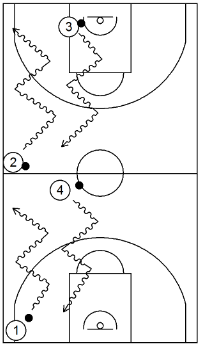
Prerequisites:
players must have a reasonable grasp of the basic technique of dribbling
Objective:
practice speed change and direction change with the ball in front
Organization:
- players dribble zigzagging between two lines along the length of the field
- when they reach a longitudinal line, they make a crossover dribble
- change direction and accelerate
- when the first dribbler reaches the extended free throw line, the next one starts
Teaching points:
- look over the ball and survey the court in front of you
- Leg on the side of the ball is in front
- hand over the ball
- crossover dribble is backwards in front of the body and low
- with an open step in the other direction
Variations:
dribble goggles use