



Basketballexercises for u22
Feint exercise
- Walk towards the defender, move your left foot to the left, as if you were passing the defender on the left
- Immediately afterwards, move your left foot to the right and get the ball very low from your left hand to your right hand, so that your back is facing your opponent
- Now dribble on and score with the lay-up

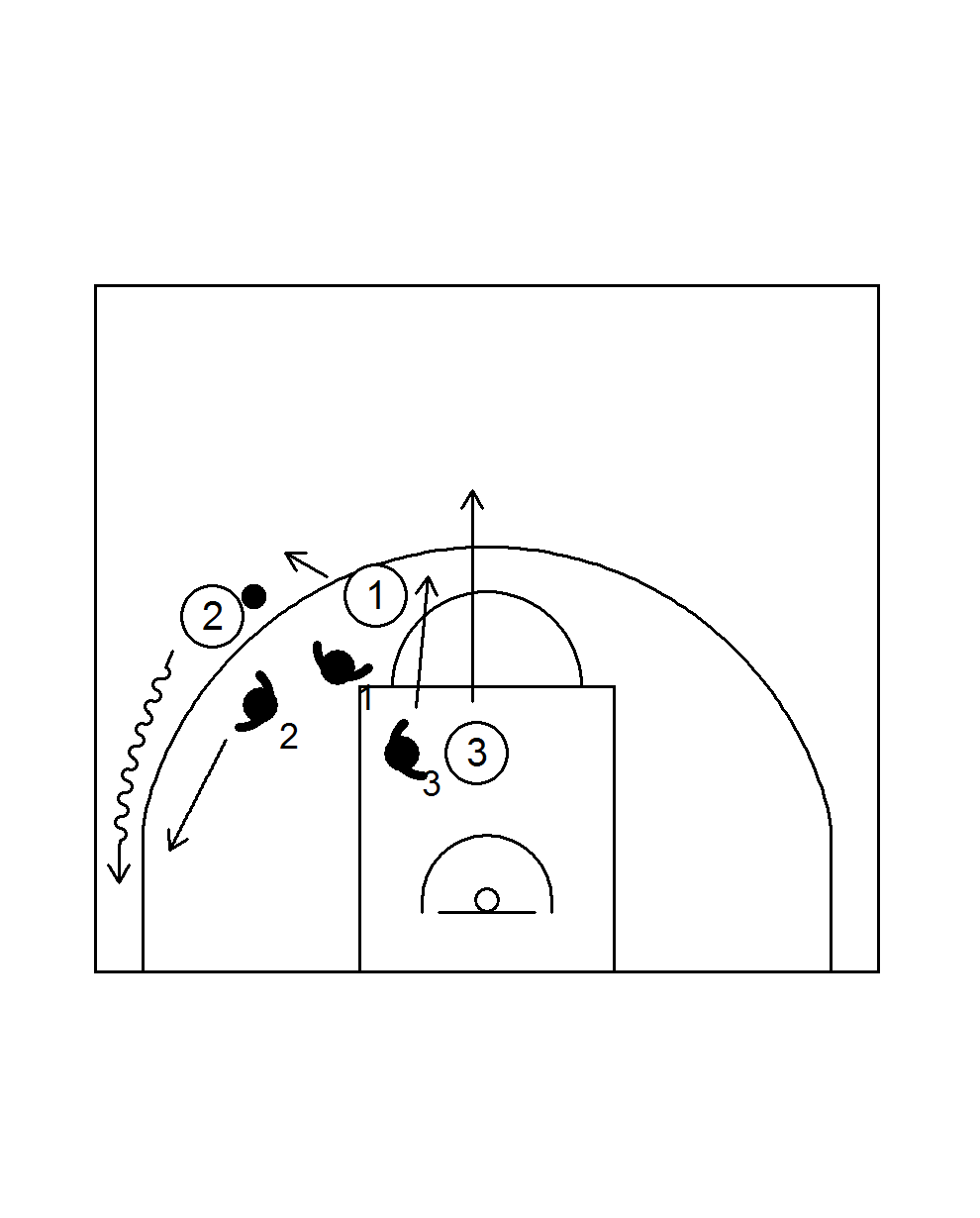
Goal: to defend one pass away
Organization:
- attackers use quarter of the field
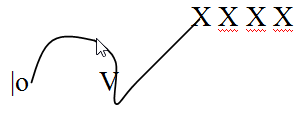
- try to get free with in-out or cut
- first restore balance by occupying the 3 positions before cutting again
- defender overplays when his man is playable with one pass
- attacker can dribble
- a waiting player counts down 20 seconds
Teaching Points:
- hand in the passing line
- front foot in the passing line
- catch your man with your forearm
- 3/4 of your attention on the man, 1/4 on the ball
- NO help
- change after x stops
Form of play:
- each team gets 5x ball possession
- who makes the most stops
- Centers + Guards + Forwards
- from U14
- 2 or more players
- 1 ball per pair
- two baskets
Prerequisites:
- players must be able to dribble a layup run
Objective:
- to increase offensive creativity in 1v1
Organization:
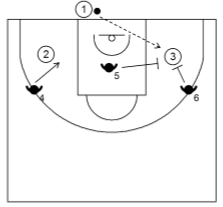
- player 1 passes the ball to 3 and gets it back immediately
- 3 moves backwards
- 1 dribbles straight at 3 and has to close the distance between both players
- Unbalance and pass the defender
- Full speed to the basket
- Loser will defend, winner will attack
- Play up to the 3 to keep the intensity high.
Teaching Points:
- attacker must aggressively close the gap
- Dribble straight at the defender.
- throw the defender off balance with a feint.
- Attacker should be unpredictable.
- only choose which side to pass on at the last moment
- Use feints in the dribble
- after passing at full speed towards the basket cut off the defender by dribbling ON the line of the defender
- basket
- after the pass, the defender has to sprint at full speed to pressure the lay up
Objective:
Reenact all the exercises, which the trainer is demonstrating.
Task:
The players stand in a (half) circle so that everyone can see the trainer. The trainer shows some exercises. The players mimic him/her. Keep the balloon in the air by tapping it up in the air. Try to clap your hands as much as possible between each tap.
- Hold the balloon in your left hand and dribble the basketball with your right hand. Successful? Try with your other hand.
- Now hold the balloon high above your head and look at the balloon. Keep dribbling with your other hand. Change hands after 1 minute.
- Dribble the basketball with your right hand and hold the balloon with your left hand. At the whistle, change hands without losing either one and without stopping dribbling.
Dribble the basketball with your right hand. Try to keep the balloon in the air with your left hand by tapping it upwards. Can you do it with your other hand?
Objective:
- Reenact all the exercises, which the trainer presents.
Mission
The players stand in a (half) circle so everybody can see the trainer. The trainer shows some exercises. The players imitate him/her.
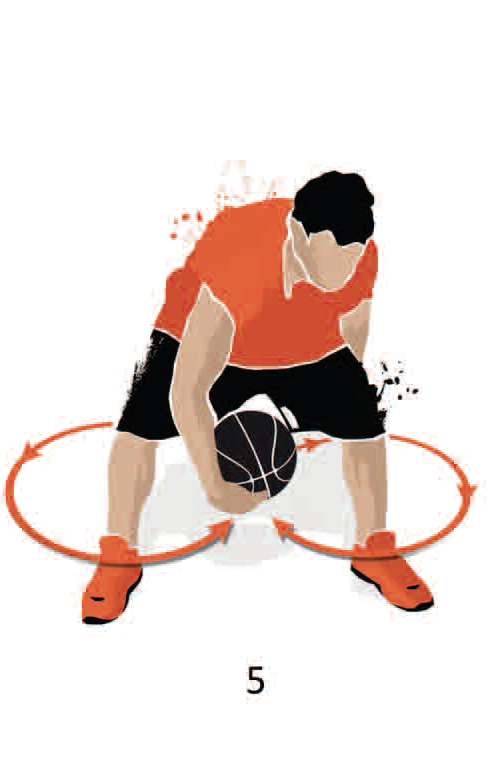
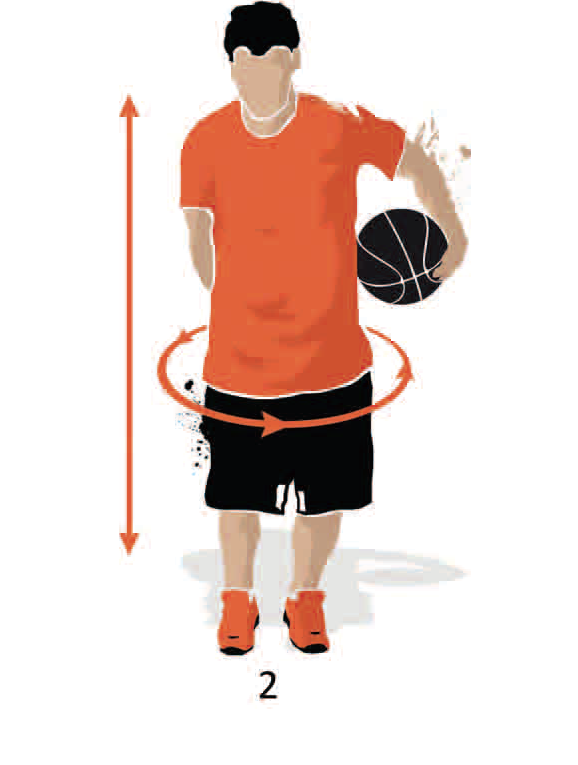
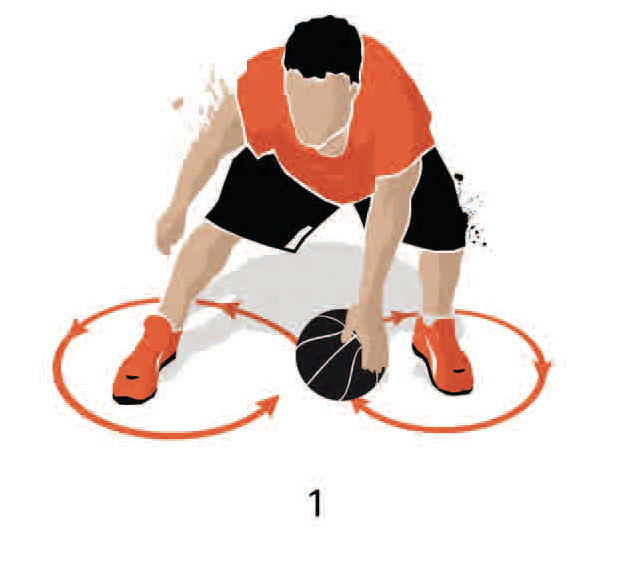
- Stand in a circle. Roll the ball between your legs in an 8-shape.
- Roll the ball around your waist, legs and head. Change direction every now and then.
- Bounce the ball on the ground with 2 hands and catch it again with 2 hands.
- Throw the ball in the air with 2 hands and catch it again with 2 hands. Who can clap before catching the ball?
- Stand in a spread position. Move the ball between your legs in an 8-shape without letting it fall to the ground.
Prerequisites:
- Players can defend on their feet
- and be able to pass
Objective:
- to practice the double team in the arrow press
- and the first rotation
Organization:
- 1 takes the ball and then does not take part in the game, but counts down the 8 seconds
- the defenders allow the first pass
- (in case of 5 players, one of the attackers starts with a pass to himself or to the other and the weak side defender counts down) Â- defender 5 starts to double team immediately after the first pass Â- the weak side defender passes the pass to the free attacker
- If the attackers get on the offensive half within 8 seconds they have a point Â- if the defenders win the ball they attack the basket. A score is a point. Â- The attacker calls when there is a foul on him. Point for the attack.
- play 5 times in a row with the same teams
- loser must run
Teaching points:
in double team, the attacker is NEVER allowed to pass between the defenders Â- the third defender must use all his energy to make the pass impossible Â- if a defender in double team is beaten by the ball, he must sprint full speed to regain a position between the ball and the half way line
Prerequisites:
players on the dribble can defend Â- and can make a pass the length of the field
Objective:
to practice defending the backfield in the arrowpress Â- to anticipate the pass and always make sure you are in a position to intercept it
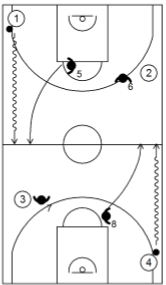
Organisation:
- 4 takes the ball and then does not take part in the game anymore, but counts down the seconds
- defender 5 applies maximum pressure on the dribbler
- the defenders can defend all over the field
- attacker 1 may only act on the defensive half Â- attackers 2 and 3 only on the offensive half
- after a stop or score, defender 5 takes the ball back for the next round
- if the attackers score within 10 seconds they have a point Â- if not, it is a point for the defenders Â- the attacker calls if there is a foul on him. Point for the attack.
- play 5 times in a row with the same defenders
- 3 new attackers each time.
- If the defenders make less than 2 stops, they must run.
- when there are 2 or more stops, all attackers must run.
Teaching points:
defend the dribbler on your feet - he may not pass you under any circumstances Â- arms wide to make a pass difficult Â- defender 6 must anticipate the long pass to intercept it Â- must position himself so that he can see the ball AND both other attackers as much as possible (split vision) Â- always adjust his position on the field to intercept the most likely pass Â- if he has not been able to intercept the long pass, Â- He must NOT allow a lay up Â- Defender 5 must then sprint full speed towards the free attacker on the weak side.
Variations:
In the beginning, you may have to limit the space for attackers 2 and 3. Use existing lines on the floor, or place pawns on the sidelines on the attacking half.
Requirements:
players must be able to individually defend the man with the ball Â- players must be able to dribble
Objective:
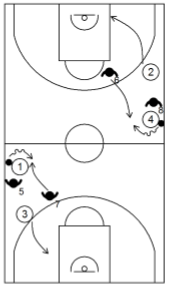
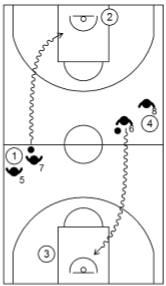
Force the dribbler to make a reverse dribble at the sideline and second defender goes for the steal.
Organization:
- 2 against 2 across the length
- losers must defend in the next round
- the trapper anticipates the reverse of the dribbler and taps the ball away as soon as the dribbler has turned 180 degrees Â- completes the lay up on the other basket
- a steal is 3 points Â- a 'normal score' by the attackers is 1 Â- the pair that has 12 points first wins Â- losers walk suicide
Teaching Points:
defender forces dribbler to the side, but must keep an appropriate distance, taking into account the dexterity and speed of the dribbler Â- defender must force the dribbler to the side so that he will make a reverse dribble
Variations:
- left and right
- with triplets half court; third defender must release his own man as soon as the attempted steal begins and cut off passing lines
Requirements:
players must be able to individually defend the man with the ball Â- players must be able to dribble
Objective:
Set up kick directly over the center line.
Organization:
2 against 2 across the longitudinal half Â- losers must defend in the next round Â- the dribbler must be over the centre line within 4 seconds (the trapper counts down)
the trapper moves aggressively towards the half way line just before the dribbler crosses it (but due to his speed and the position of his defender is not able to change direction) Â- the trapper widens himself, but moves the foot closest to the touchline backwards slightly, so that he can close the touchline with 1 or 2 slides Â- the dribbler must never pass between the two defenders
As soon as the dribbler grabs the ball, the trapper stays with it Â- the other defender sprints towards the free attacker
Teaching Points:
defender forces the dribbler to the side, but must keep an appropriate distance, taking into account the dexterity and speed of the dribbler Â- defender must force the dribbler to move at high speed along the touchline to the attacking half
Variations:
left and right
Requirements:
Players must be able to sprint and slide and switch between them Â- Players must be able to dribble
Goal: Press
the dribbler on the press
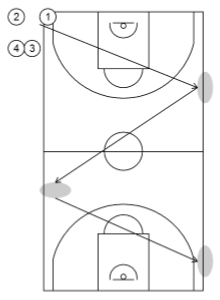
Organisation:
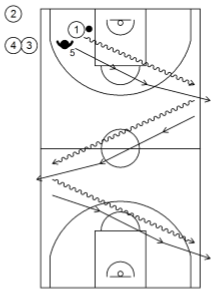
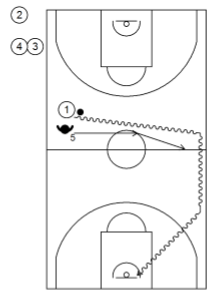
Have each player sprint fully along the drawn lines and always close off the touchline (set up cones) idem but now with slides idem with alternating slides - sprint - slides Â- attacker without ball. Defender must make slides as long as possible; sprint if necessary Â- defender must close off the sideline in any case Â- same with ball. Defender forces attacker to turn on the sideline Â- keep exercise short and intense
Teaching points:
defender should get as close to attacker as possible, taking into account dexterity and speed of dribbler Â- defender should close off sideline with foot, forcing dribbler to turn Â- defender should accelerate, get in front of dribbler before closing sideline
Form of play:
if the dribbler manages to dribble between the sideline and the defender, then he may score Â- defender then continues to defend Â- if the defender manages to make the attacker turn at the sideline then he may then dribble and the attacker becomes defender
Tips:
start with a weak dribbler and let him start with his weak hand Â- impose restrictions on the attacker in the beginning: he can only change speed, but not direction, except on the touchline Â- reduce the restrictions as the defenders get better
Requirements:
- players must be able to drive and shoot individually from the 3-point line
- be able to screen
Goal:
keepperimeter
players moving while making good use of space on the court
Organization:
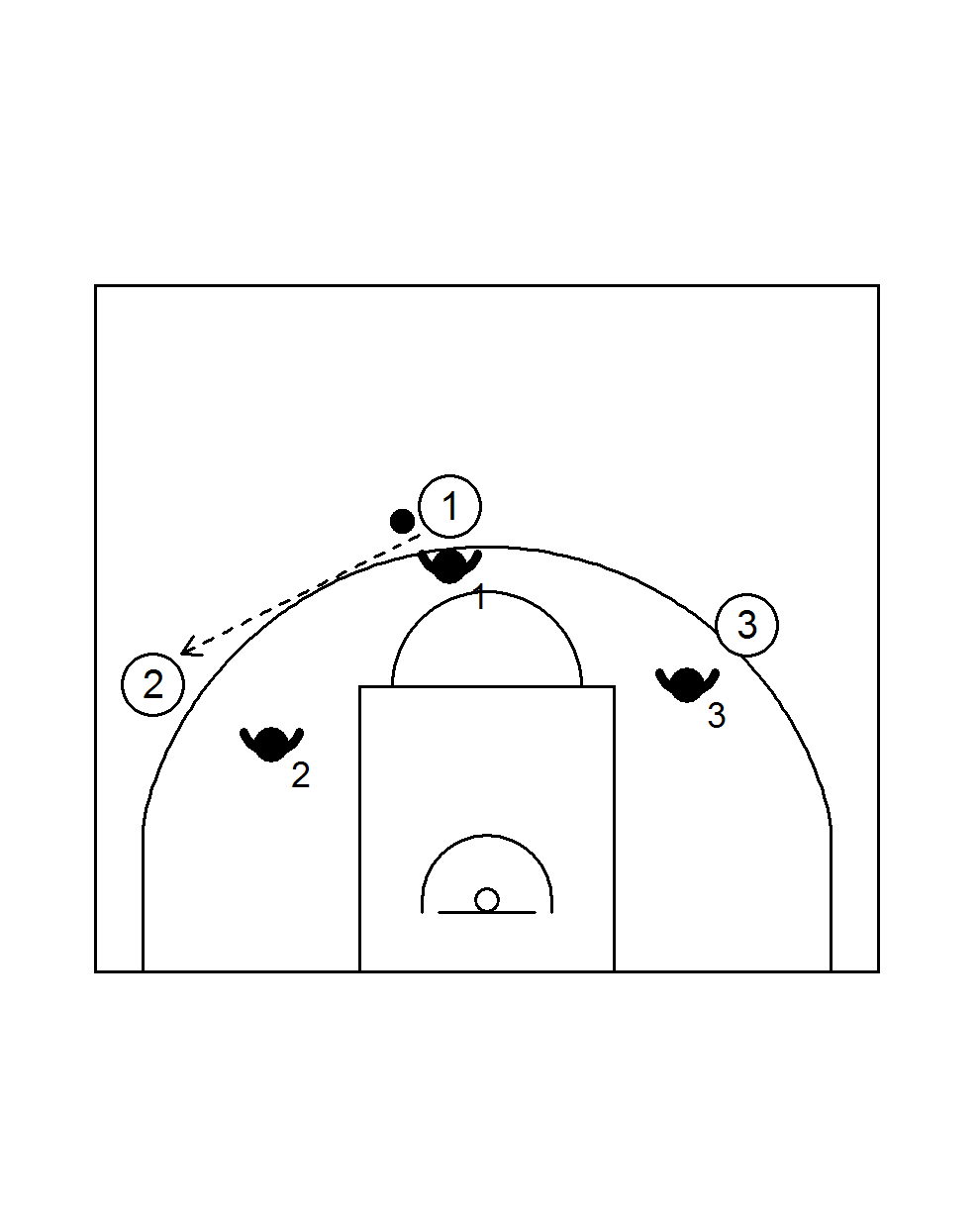
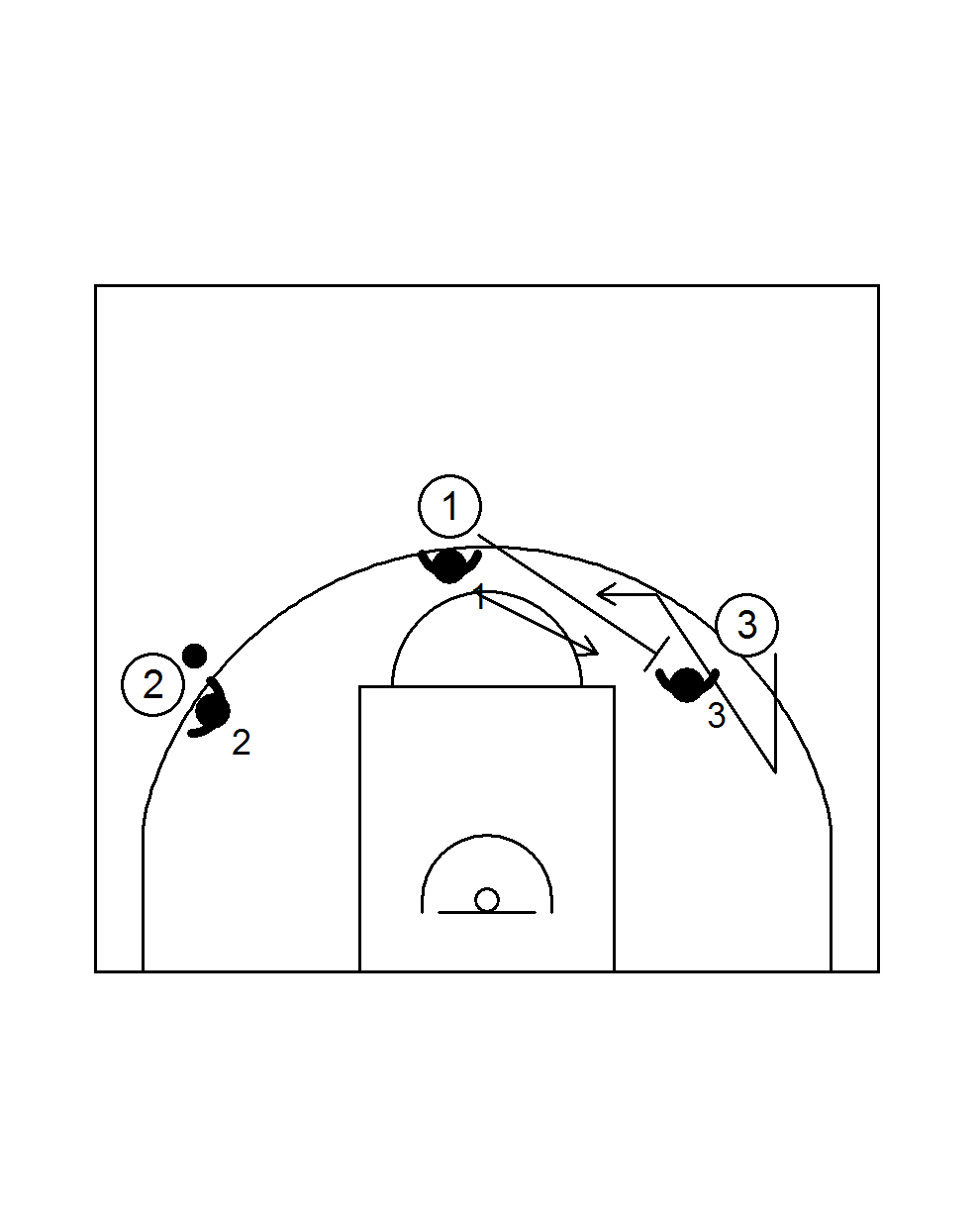
- the attackers get free with in-out, pass and screen away, back through, cut in etc
- always make sure there is about 3 metres space between the attackers
- the player who receives the pass turns with a front or reverse pivot towards the basket.
- by constant movement and changes of position they try to create space for a shot or drive
- a player in the three-point zone can only be played if he can score immediately
Dribbling only to:
- restore space between the attackers
- Finish a lay up
- obtain a position to pass
- get out of trouble
Teaching Points:
- look at your team-mates and react accordingly
- As soon as you have the ball, face the basket
- Dribble only with a clear goal
- always recover 3 metres of space after a running action or a screen.
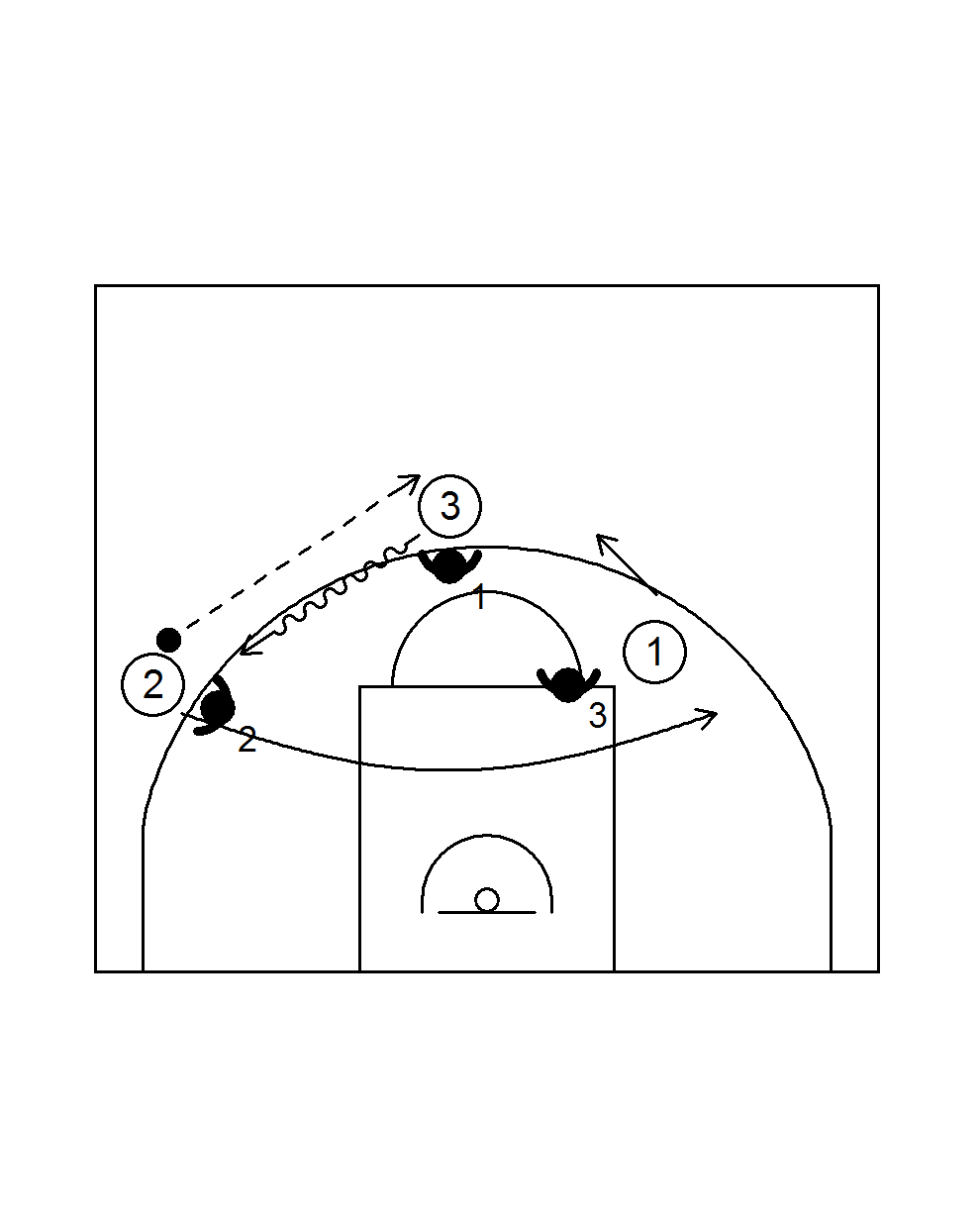
Example:
- 2 passes back to 3 and tries to cut in front of his man to the basket
- 3 cannot make the pass due to good defensive work
- 3 dribbles to the forward position to redistribute the space.
- 1 takes the safety guard position
Requirements:
players must master the layup at full speed
Goal:
reactquickly
to a stray ball and be able to finish the next 1 on 1
Organisation:
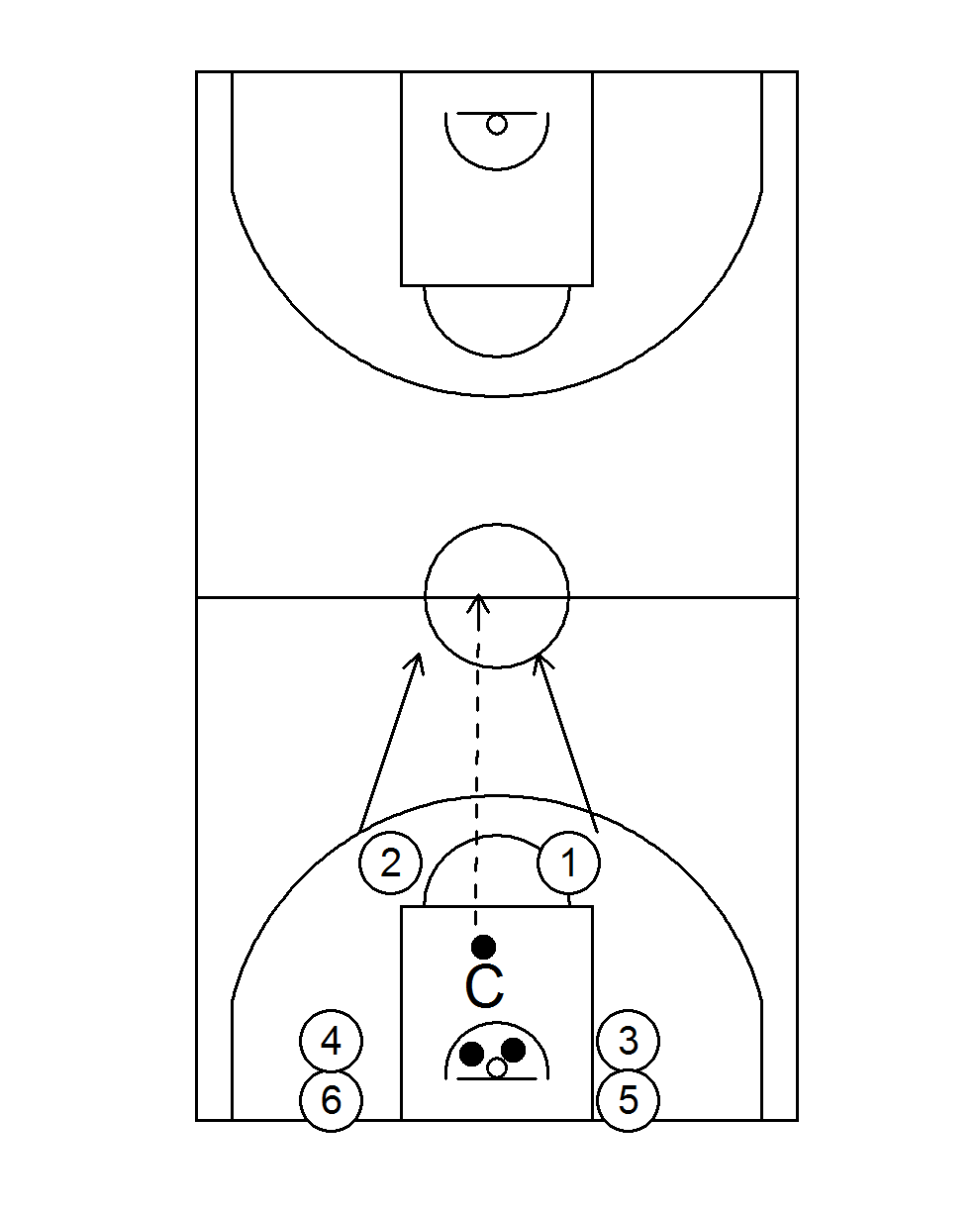
- the coach stands in the middle of the bucket and has the ball
- Two players on the elbow are only allowed to look straight ahead.
- trainer passes between the players
- they may only move when they see the ball
- the player who captures the ball scores on the opposite basket
- the other player tries to prevent this
- the coach makes his passes so hard that the players have to sprint to keep the ball in.
- n.b. the defender must not make any mistakes due to the risk of injuries
Teaching points:
- speed of action
- do not let the defender distract you
Variations:
- have players start sitting or lying down
- Put two players next to each other on the elbow, or with their backs against each other. Then play 2 against 2
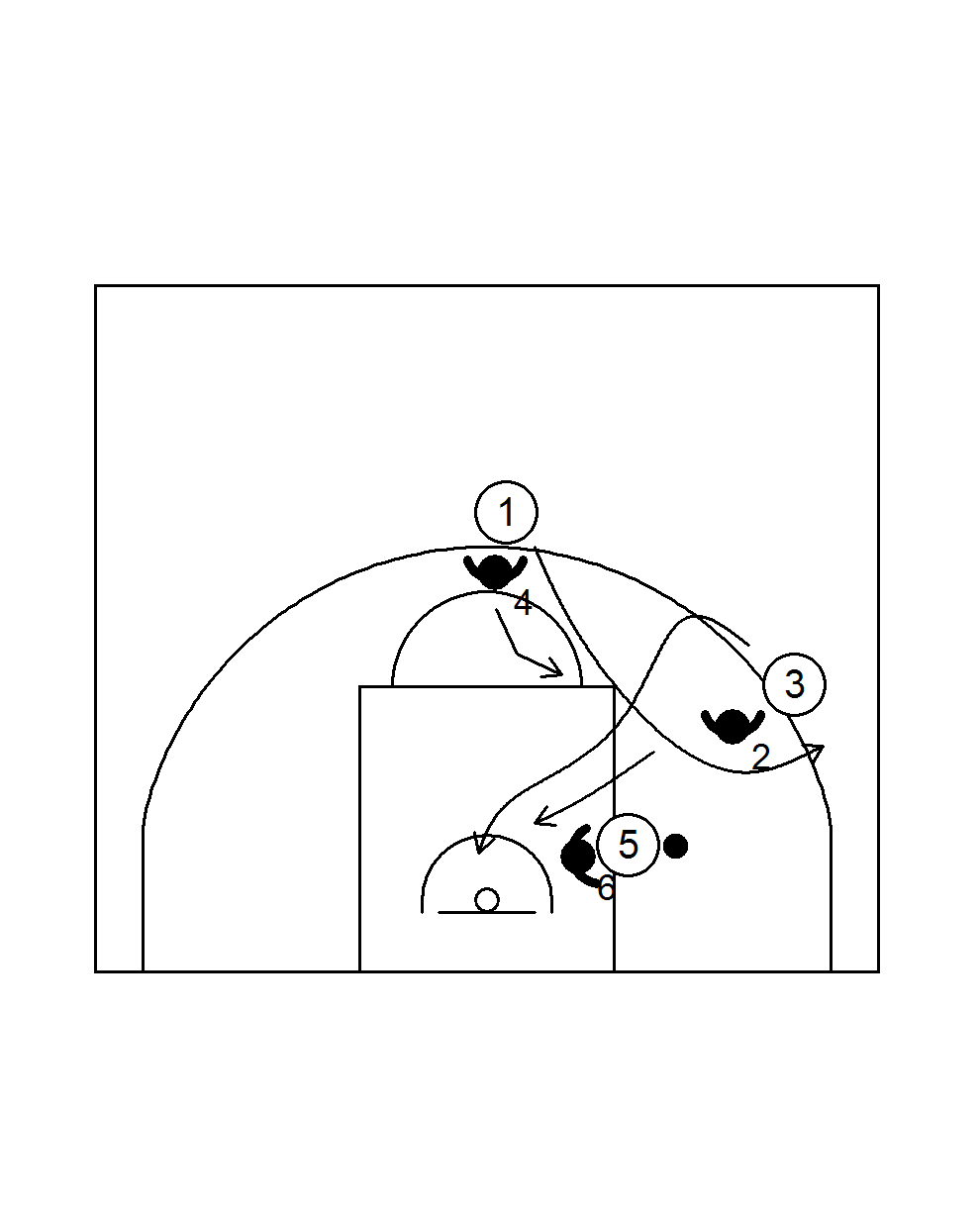
Requirements:
- players must be able to drive and shoot from the 3-point line
- forward 3 must be able to apply pass fakes to feed the post
- the centre 5 must master the fundamentals to keep his defender behind him and to be playable with a bounce pass (or with a lob when he is lost)
- the center must master the fundamentals to be able to play 1 on 1 from the block
Goal:
trainsplit
the low post
Organization:
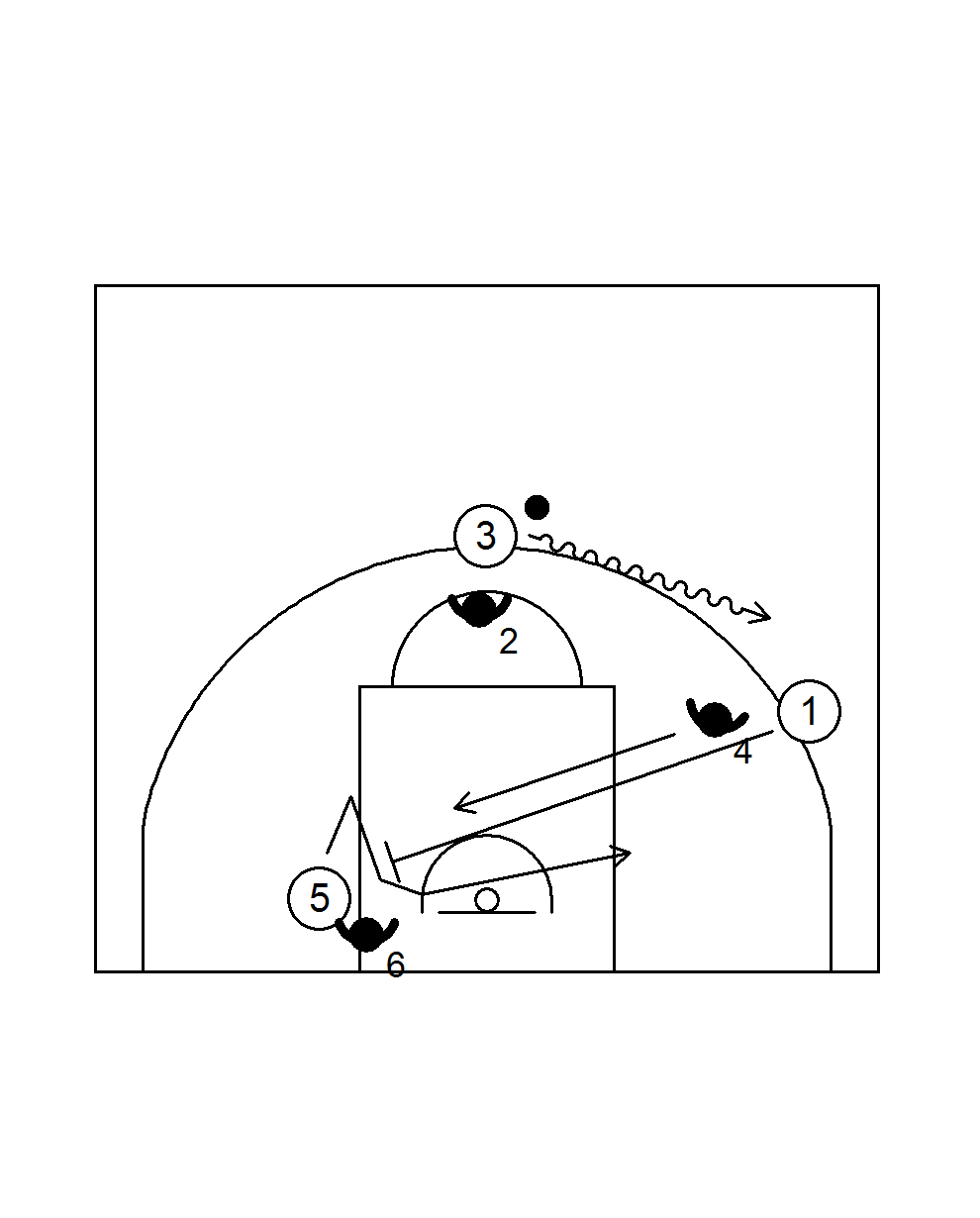
- 5 stands extremely deep, near the bottom line
- as soon as 3 starts to dribble, 1 starts to screen for 5
- 5 crosses over to the block on the other side.
- 1 fills the guard position
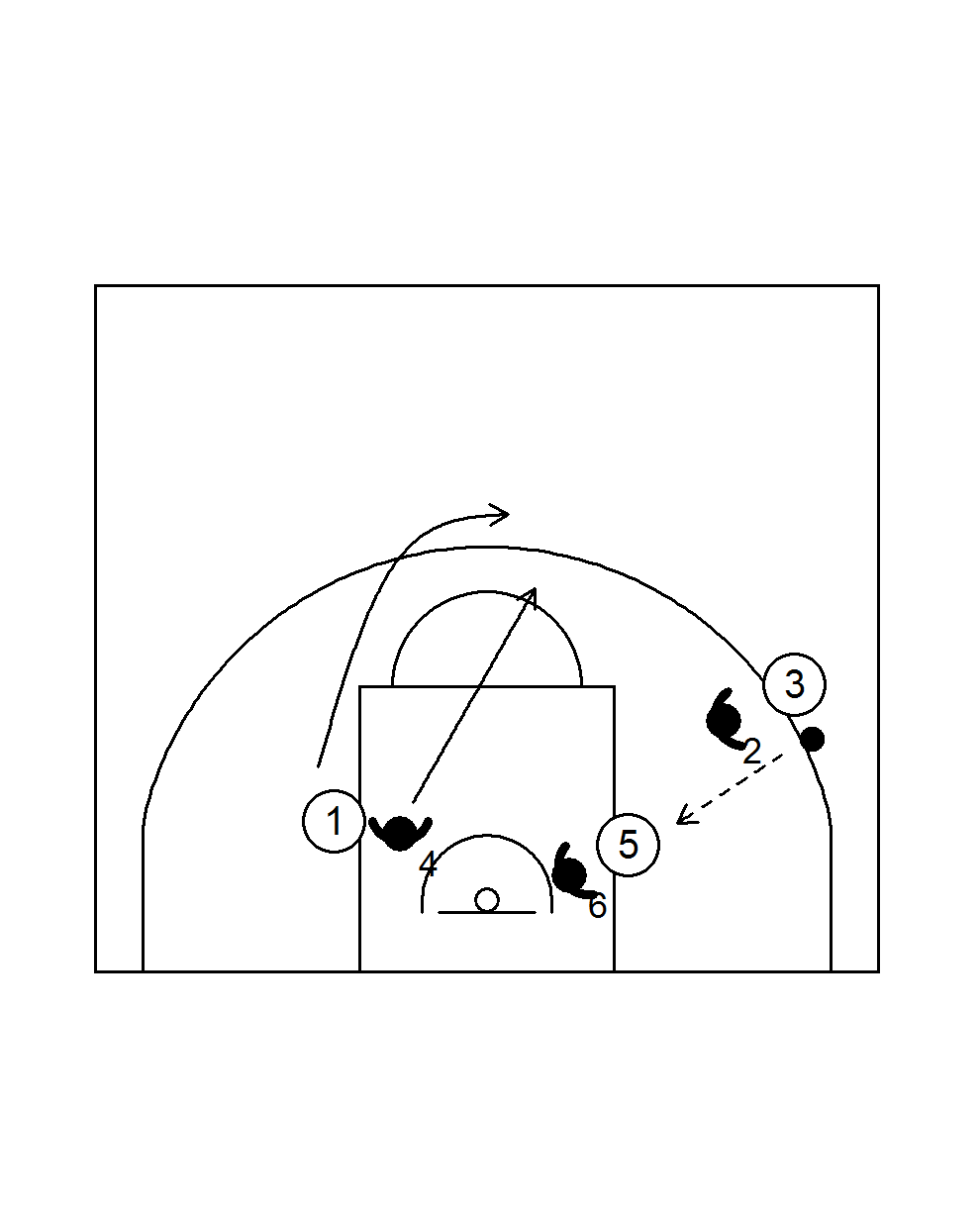
- as soon as 3 has adjusted the post, he cuts across to the ring
- at the same time, 1 sprints to the corner for the shot
5 has 3 options:
1) adjust 3 for the lay up2
) adjust 1 for the shot3
) play 1 against 1 himself against 6
Teaching points:
- timing: the pass to the center must come at the moment it arrives on the block
- at the split, leave enough space for the (bounce) pass.
- 1 immediately sprints to the corner as soon as the pass is made, so that defender 4 is hindered by in cutting 3 and his defender
Variations:
- in preparation run 3 against 0 and systematically go through the various options.
- left and right
- Cut below
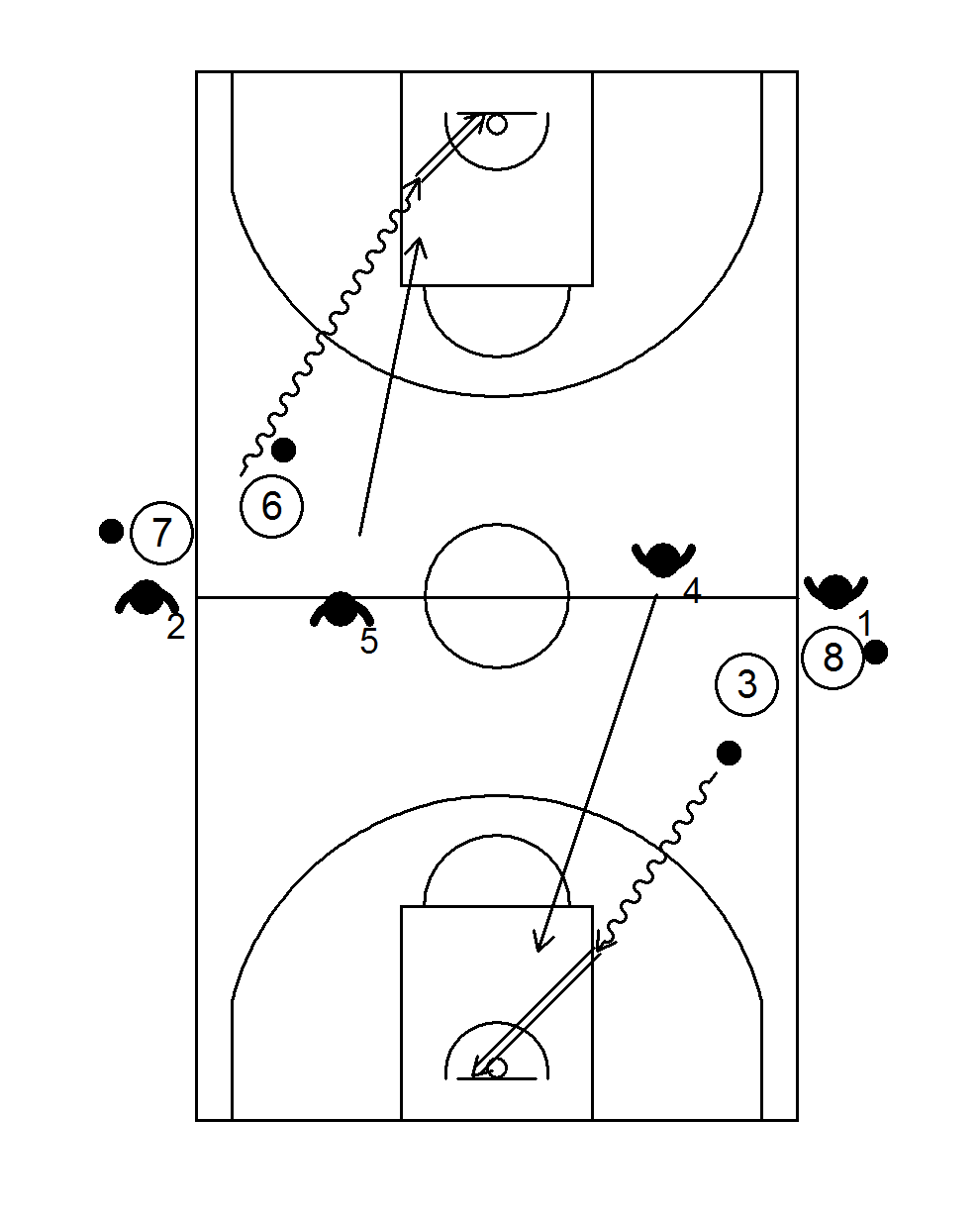
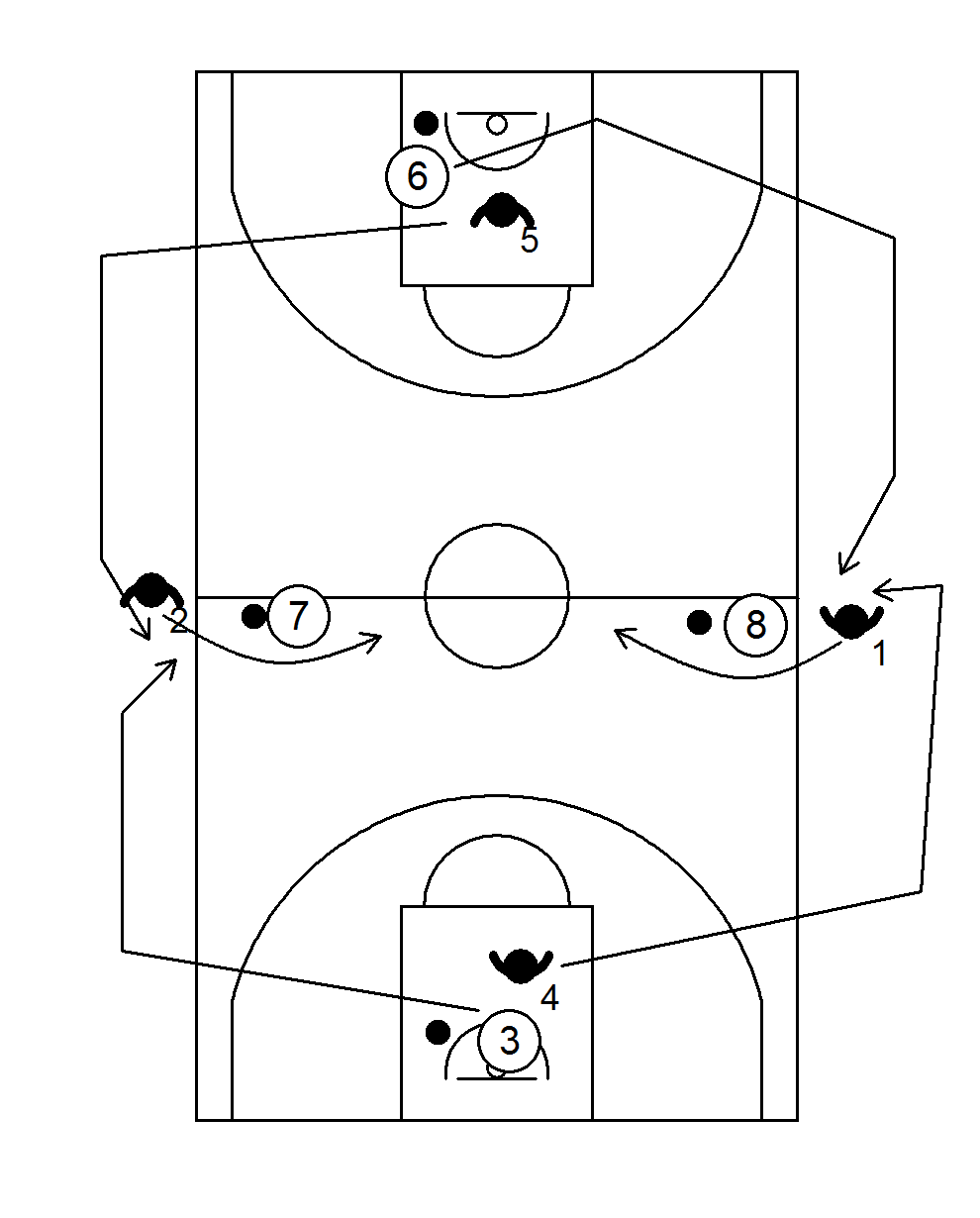
Prerequisites:
players must master the layup at full speed
Goal:
Dare to finishthe
layup under pressure of a following defender
Organisation:
- defender may only cross the half way line at the first dribble
- attacker may make feints
- if the defender steps in, he/she must put both feet behind the centre line before defending again
- Attacker dribbles as fast as possible to the basket and finishes with a layup.
- Finish with a layup
- winner takes ball and connects behind the attackers on the other half of the court
- loser defends on the same half.
- depending on the skill of the attackers, allow the defender to cover more or less distance
Teaching points:
- dribble at full speed
- do not let the oncoming defender distract you.
Variations:
- increase the pressure by having the defender start closer to the basket
- Have players start sitting or lying down. The defender can only get up after the attacker.
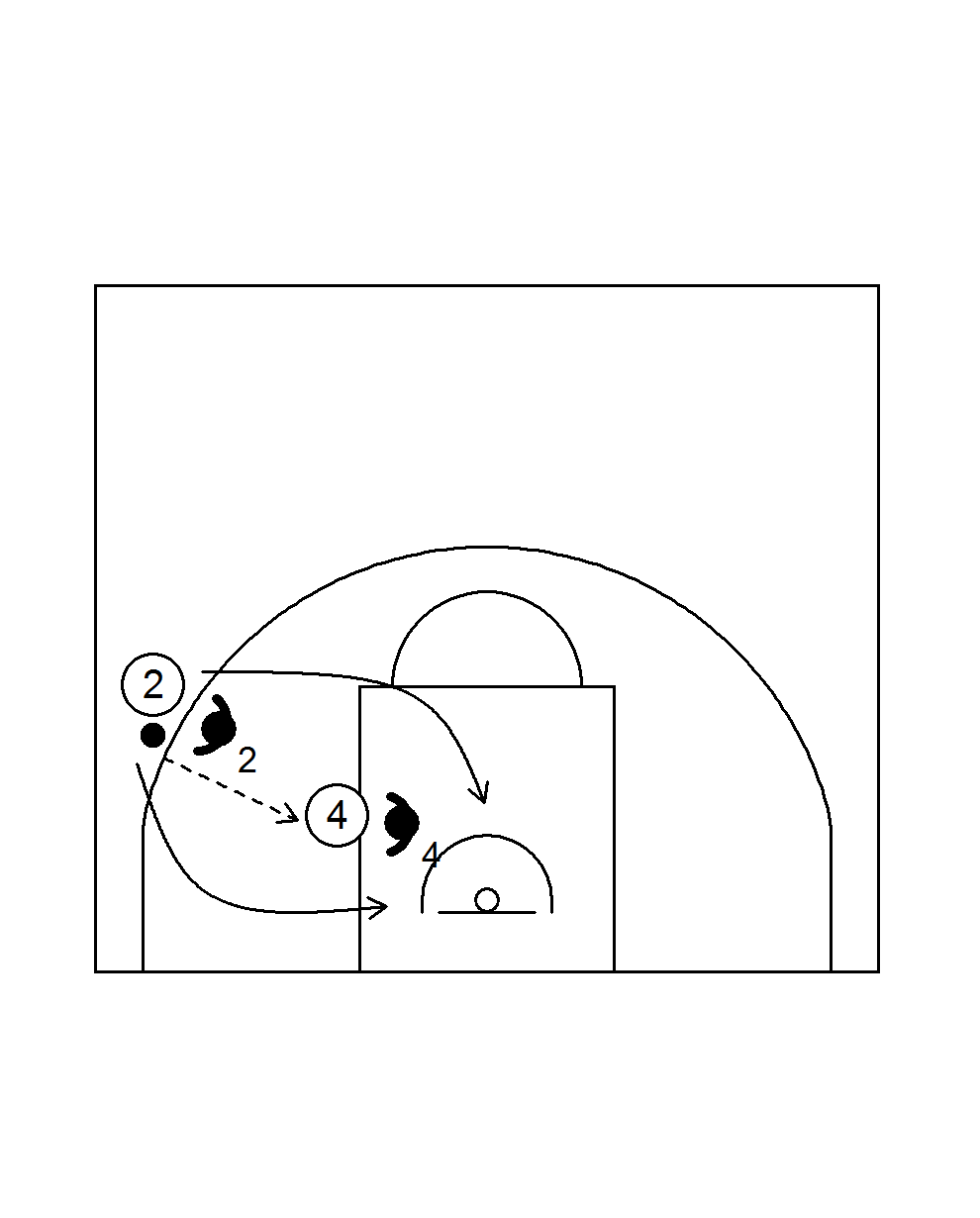
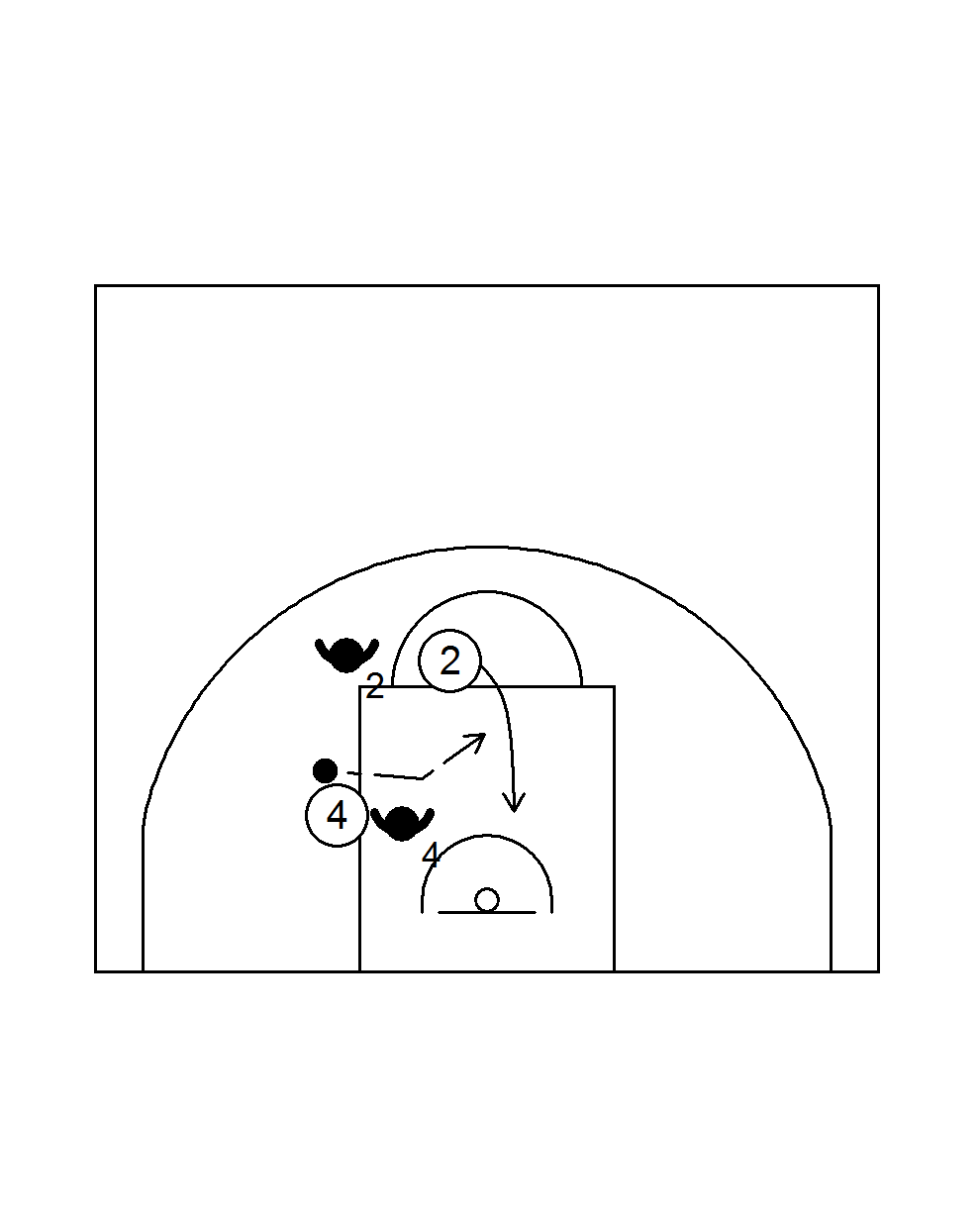
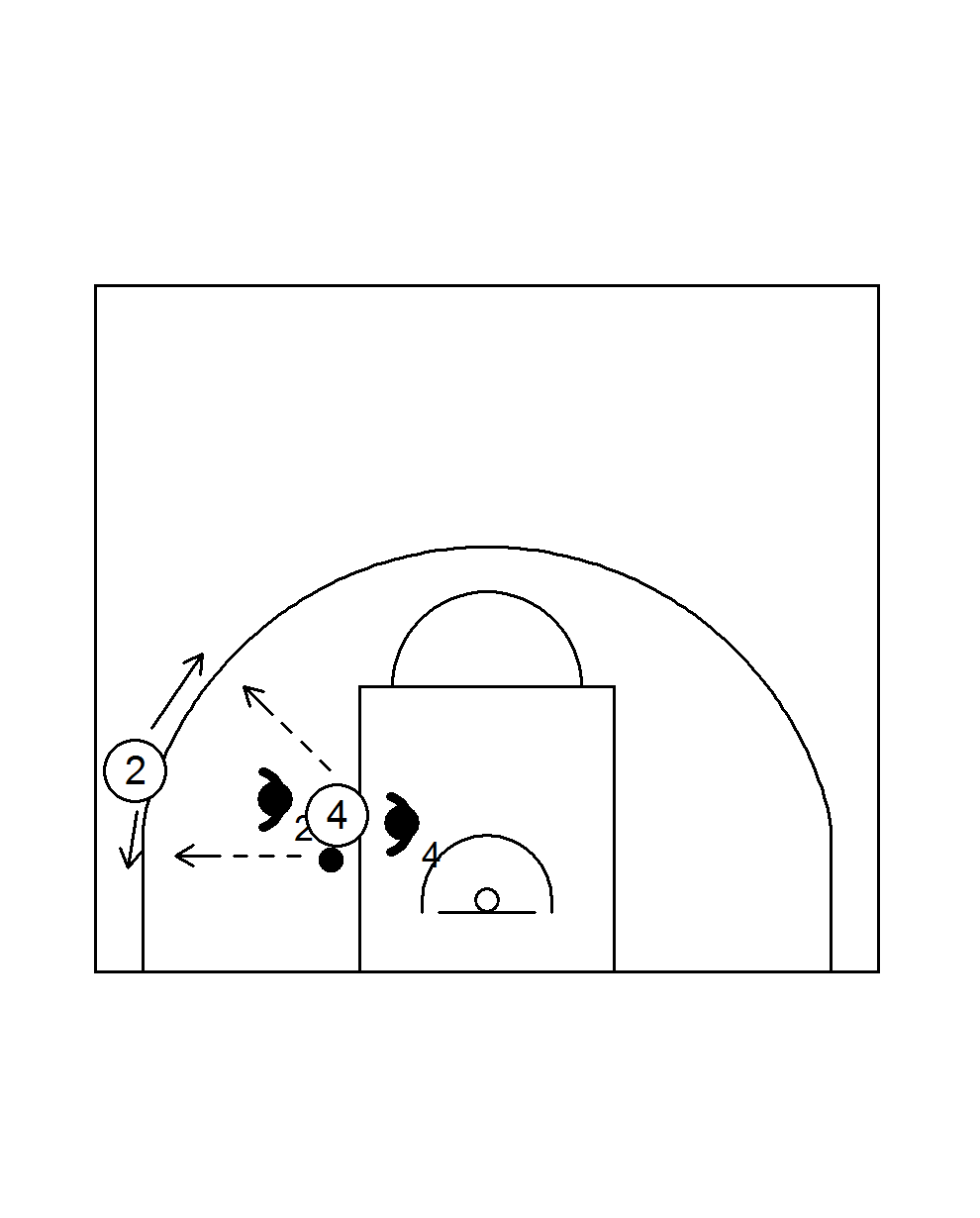
Prerequisites:
- forward must be able to play mid post (pass fakes, flat bounce pass)
- Forward must be able to make a lay up or lay back directly from a bounce pass in the run
Goal:
To teach the forward to read the defense and to choose the appropriate offensive line
Concepts:
cutter = forward who cuts in
Organisation:
- the centre is allowed only 1 dribble
- forward may only make 1 dribble after a shot fake, otherwise not allowed
- make it - take it
- play up to the 5
Teaching points cutter:
- cut with sufficient distance from the centre: over the elbow or over the dead ball line
- choose the side that leaves the defender free
- Prepare a front pass in the opposite direction and rebound hard in the desired direction
- keep your hands ready for the bounce pass
- run to the weak side for the three-point shot if you don't get the ball right away
Continued:
- centre can play 1v1
- or use it to threaten and pass for the three-pointer
- If the defender plays double down
- then the forward looks for a shooting position where the center can see him and adjust: don't stand still!
- after the pass to the outside, take the shot immediately
- or readjust the center
- and find a shot position again
Teaching points:
- speed of action: one fake and then act immediately
- watch what the defender does and take up the space he does not defend
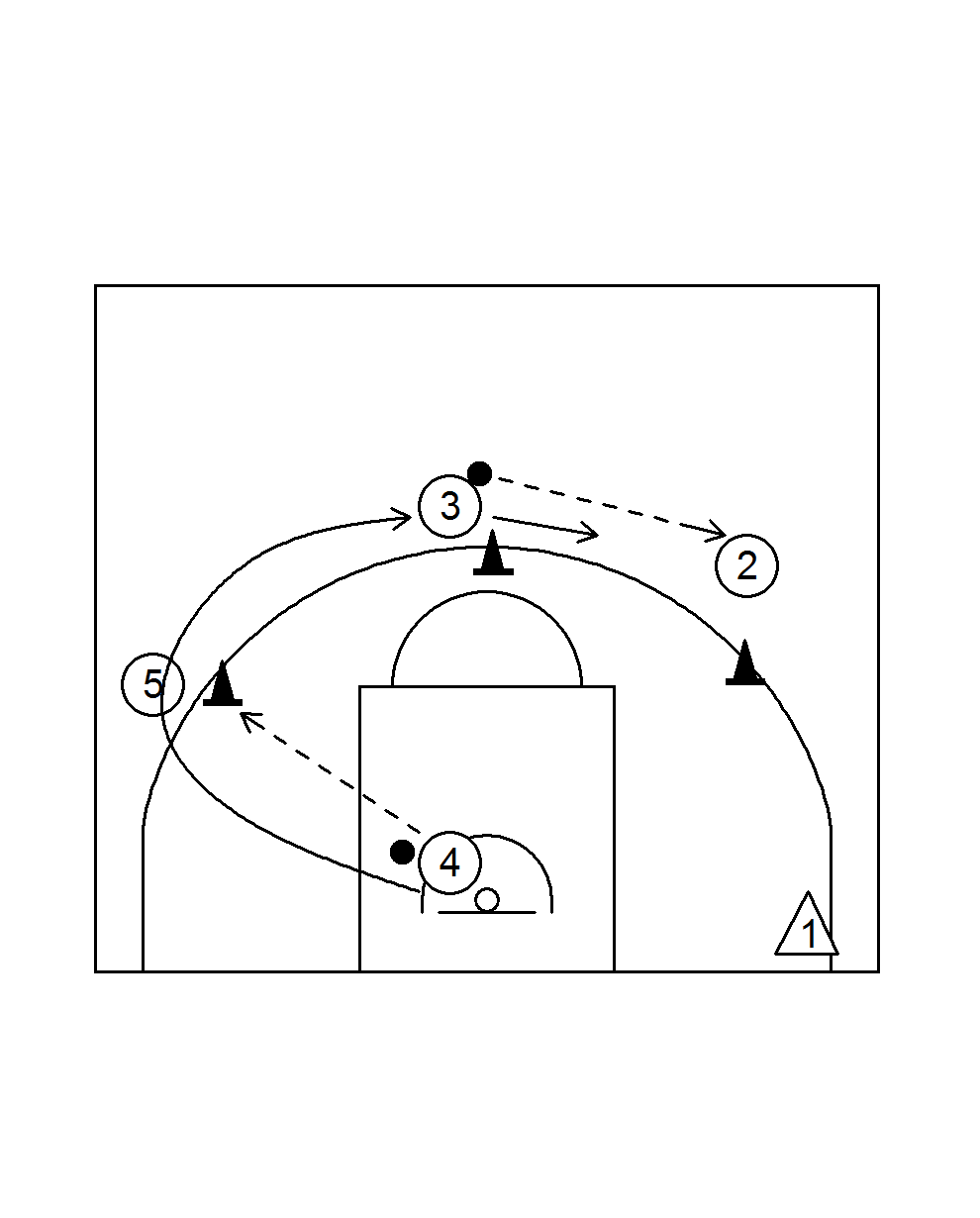
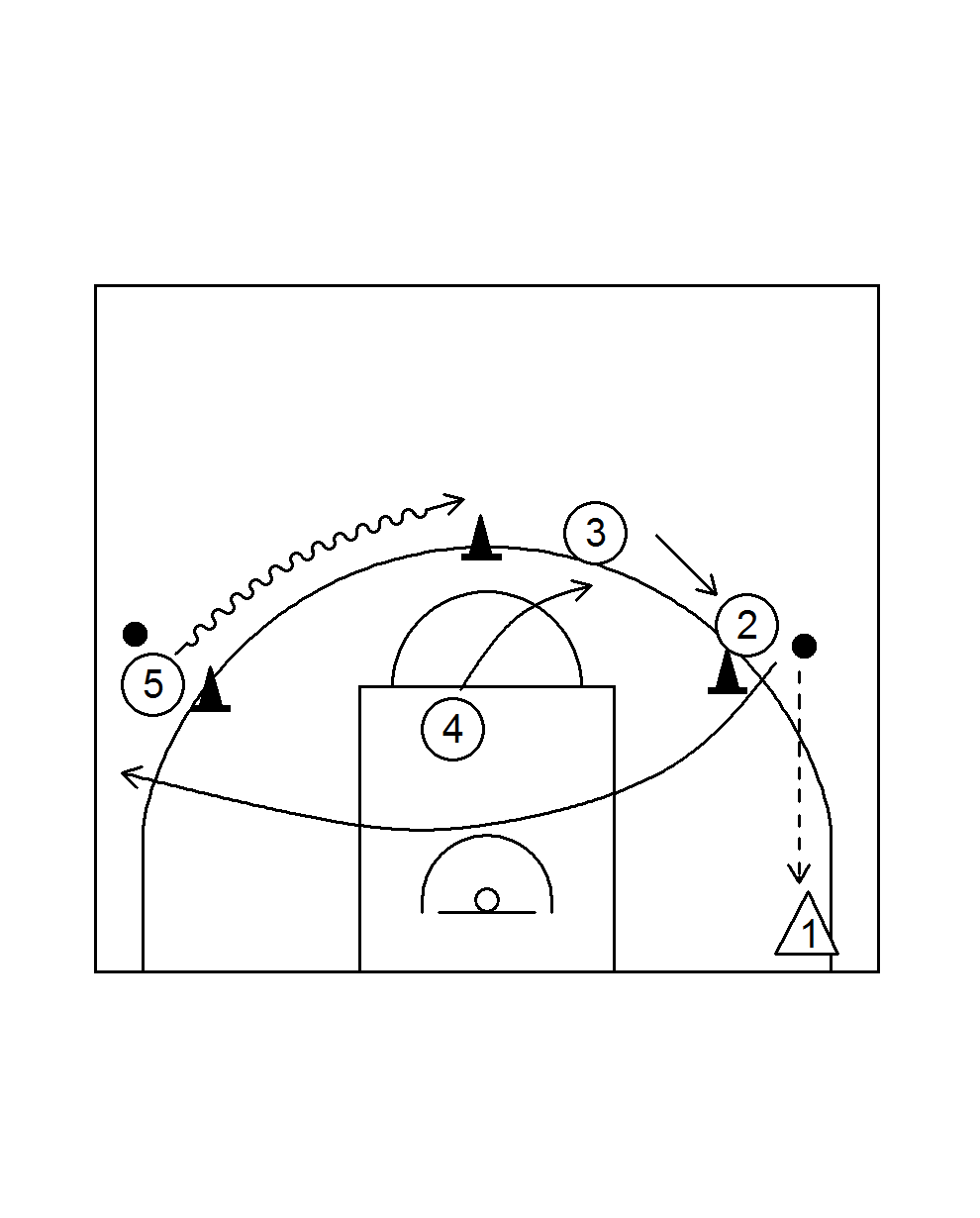
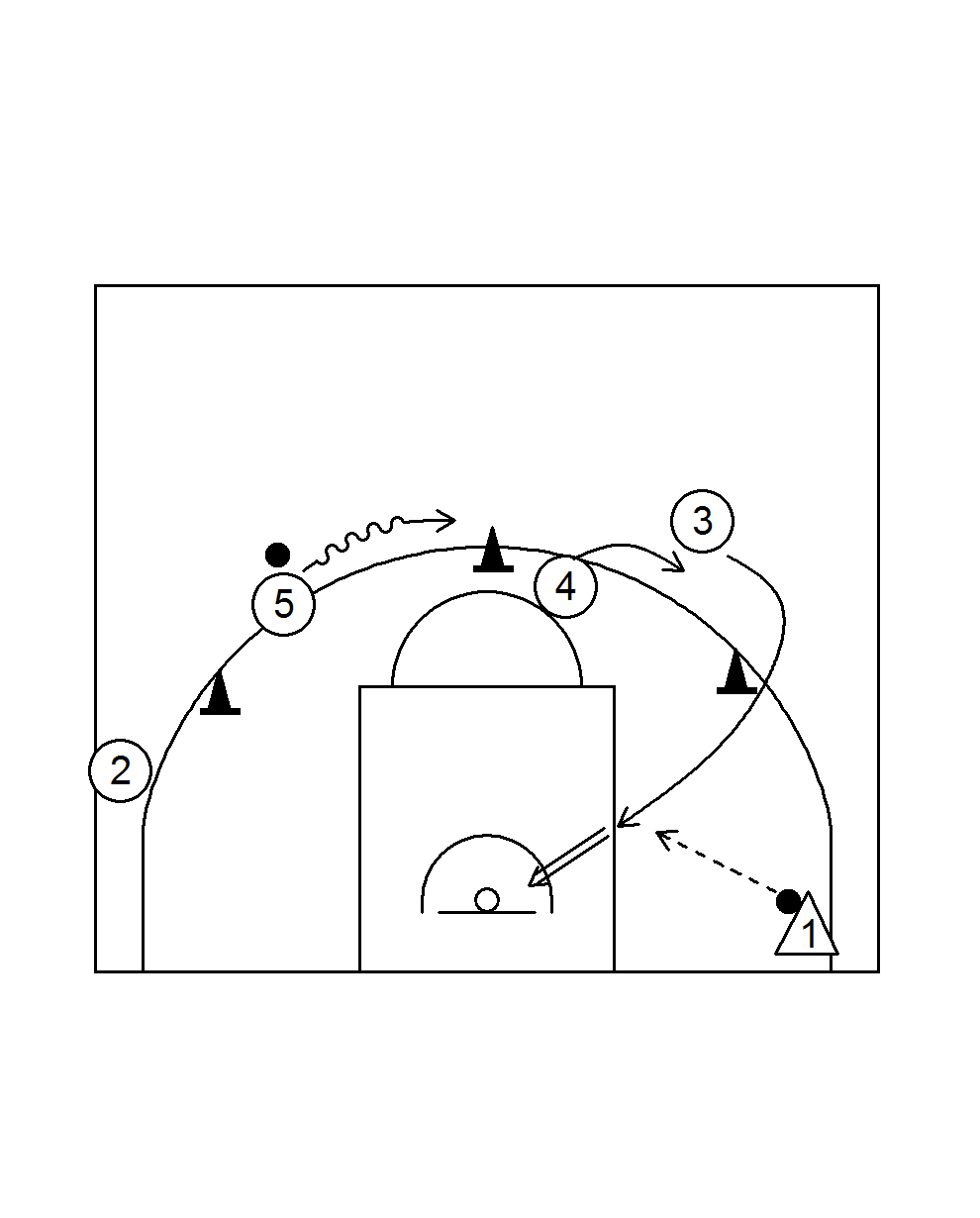
Requirements:
players must be able to make a lay up from the pass
Goal: learn the
running move to free another player + have the courage NOT to pass to the first man who moves
Organisation:
- 3 pawns
- fixed pair
- fixed passer in the corner of the field.
- adjust deep post
- cut in, ask for the ball and pass
- second incider gets the ball and makes the lay up
- catches it himself
- passes to the oulet
- and runs to the pawn on the other side of the free throw line
- in the meantime, the man with the ball dribbles to the next pawn
- passes to his regular teammate
- who passes to the regular passer in the corner
- cuts in and asks for the ball (but does not get it)
- when there are more than 10 men: make 5 free throws and then change with a fixed passer
Teaching Points:
- the first man to cut in must look at the passer and ask for the ball with his hands
- the passer must use pass fakes to keep his defender out of the pass line until the second man cuts in
Variations:
Left and right
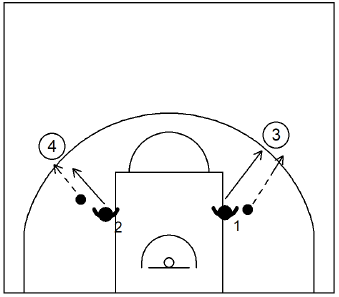
Requirements:
- players must have the courage to shoot defensively
- master open step and crossover step
- and master a feint followed by a dribble + shot or drive
Objective:
to decide which action to take as a forward in a 1v1 situation
Organisation:
- defender passes the ball with a bounce pass to the attacker
- and starts defending
- Attacker stands within shooting distance
Teaching points:
- foot, knee and shoulder in one line
- Hands ready to shoot
- Knees in an angle of 60 degrees (shot fake) to 90 degrees (drive fake)
- Shot fake: ball not higher than the nose + bend the knees a bit
- Drive fake: short, quick step + forward movement with the shoulders
- Open step: first step is short
- Bringing the ball to the other side with sweep/rip: bring the ball below knee height
Decide:
- defender has his hands low and/or more than an arm's length away: shoot (quick draw)
- Defender has his hand on the ball: driven directly (preferably over the front foot / along the back of the defender)
- make one fake at the most. Read the defender's reaction during your fake.
- If the defender does not react, continue the move (fake shot becomes shot, fake drive becomes drive).
- if the defender reacts, take the other option, i.e.: fake shot becomes drive; fake drive becomes shot; open step becomes rip + crossover step; crossover step becomes rip + open step
- do NOT introduce an element of competition here, to prevent defenders from making hard mistakes to avoid losing
Variations:
- instruct the defender to only defend the drive hard and leave space for the shot
- defend crossover and shot, but leave open step
- defend the shot to the full
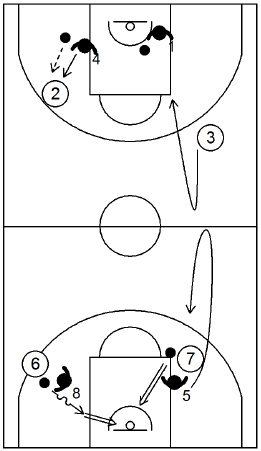
Requirements:
- players must have the courage to shoot defensively
- and control a feint + dribble + shot or drive
Goal:
practice1
against 1
Organisation:
- after a goal attempt, each player catches his own ball
- waits until his team-mate is in his shooting position.
- passes the ball and defends the attacker.
- the attacker uses the space left by the defender for a shot or drive
- or lures the defender towards him with a shot fake and then makes a drive to the basket
- OR a bounce + step + shot
- do NOT introduce an element of competition to prevent defenders from making hard fouls to avoid losing.
- Make sure the attacker gets the ball where he can actually shoot, so the defender has to consider the shot AND the drive.
Teaching points:
- Catch the ball in your shot hand (ready to shoot).
- adjust shooter well
- shooting technique
- if a player never shoots but always makes a drive, instruct the defender to only defend the drive hard and leave room for the shot
Variations:
- shot distance
- Position in relation to the basket.
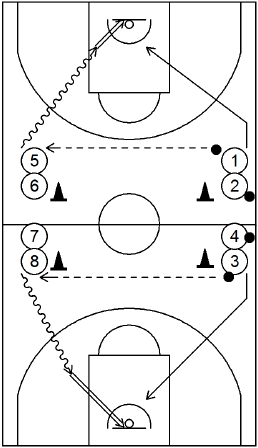
Prerequisites:
players must master the layup at full speed
Goal:
daring to finishthe
layup under pressure of an approaching defender
Organisation:
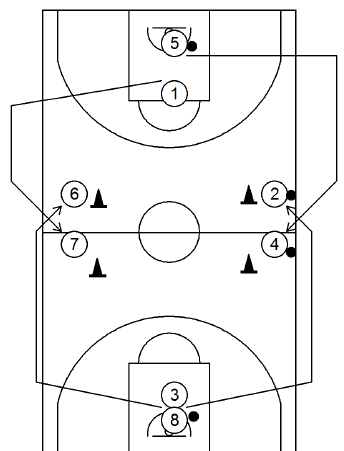
- set up pilons for positioning
- passer (1) plays the attacker (5) with a baseball pass and starts defending
- the attacker dribbles as fast as possible to the basket and finishes with a layup.
- finishes with layup
- loser takes the ball and joins the passers.
- winner connects with the attackers
- depending on the skill of the attackers, move the pylons to allow the defender to cover more or less distance.
Teaching points:
- dribble at full speed
- do not get distracted by the oncoming defender
Variations:
- increase pressure by having the defender start closer to the basket
- Put hoops down and let players start with their back foot in the hoop.
- Have the defender start at the three-point line and instruct him to stand for the charge. The attacker must then change direction at full speed to avoid the charge and still score.
Requirements:
- players must be able to individually defend the man with the ball
- Players must be able to dribble
Goal:
fitness / intensive interval training
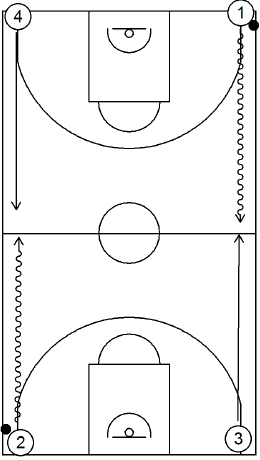
Organisation:
- players start with 1 foot on the back line
- start on signal of the coach
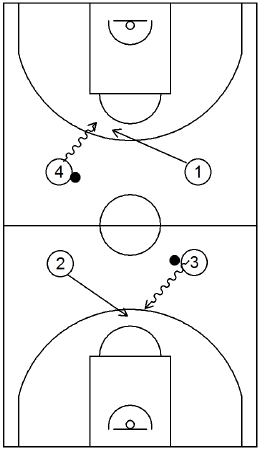
- loser takes the ball and has to defend in the next round.
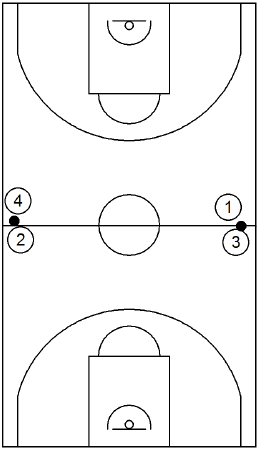
- 1 and 2 place the ball on the middle line so that 3 and 4 can pick it up
- 1 and 4 play 1 against 1 on the basket on the side they came from
Variations:
- left and right
- Place a hoop just beyond the baseline to handicap the defender.
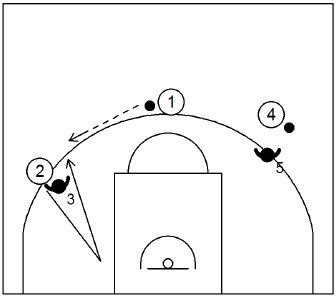
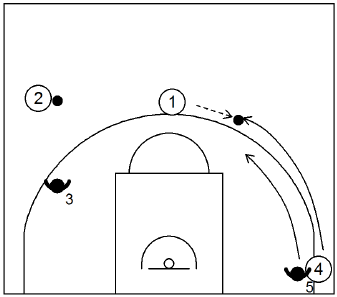
Requirements:
players must be able to drive and shoot from the 3-point line
Goal: forwards
learn to get free by reading the defense
Organization:
Defender is instructed by the trainer how to react when the attacker cuts inside for the first time:
- stay put
- pass
- stick to the attacker
- passer static on the guard position
- passes to the attacker when he gets free
- who then plays 1 against 1
- loser defends on the same side
- winner takes the ball and attacks on the other side
- play until the 4
Teaching points:
- defender stays put: step outside the three-point line for the shot
- Defender overshoots (you can't see the ball well because the defender is in between): go back through (explosive, hard offload on your outside leg)
- defender sticks: pin and spin (after the spin make your line form the letter V, so the defender stays behind you and cannot intercept the pass)
- if the attacker is still not free after 2 times, then the defender has won
Endgame:
Let the defender vary the way he/she defends so that the attacker really has to read and react appropriately.
The trainer instructs the defender to successively:
- follow
- pass
- stick
- Attacker starts against the back line
- moves parallel to the bucket towards the ball
- if the defender follows, accelerate at the elbow by pushing off hard on the inside foot and step out perpendicular to your line of play
- if the defender sticks, then perform a pin and spin on the elbow and step out hard perpendicularly
- if the defender sticks at the elbow: ask for the pass at the three-point line and shoot
- if you cannot see more than the defender's hand between you and the ball, call for the pass with your outside hand at the three-point line
- after catching the ball, rip it and drive directly to the basket
- if you see the defender's shoulders between yourself and the ball, then drop off hard on your outside foot and go back through (ask for bounce pass on your outside hand)
Endgame:
Defender varies the way you defend, so the attacker really has to read and react appropriately
Mtm offense
- Coach instructs defender to consecutively:
- keep position between attacker and basket
- Pass from the extended free throw line.
- Attacker runs outside along the three-point line:
- If the defender stays between man and basket, call for the pass with your outside hand at the three-point line.
- Take your triple threat position and play 1 against 1.
- if you can see the defender's shoulder when looking at the ball, then push hard on your off-side foot and go back through (ask for bounce pass on your off-side hand)
- Same if the defender puts a foot over the three point line
Endgame:
Defender varies the way you defend so the attacker really has to read and react appropriately
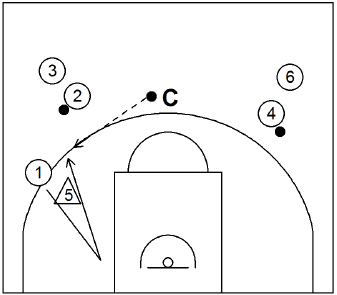
Requirements:
players must be able to drive and shoot from the 3-point line
Goal: get free
at the forward position and improve scoring ability from that position
Organization:
- coach dribbles at guard position
- occasionally threatens to penetrate and defender 5 must step in. He always has to defend the ball as well!
- Forward makes sure he gets free with an in-out move, backdoor or pick-up + flash
- gets free
- then plays 1 against 1
- Loser goes to defend
- catch it yourself, dribble to the other side than where you started.
- play until the 3
Teaching points:
- face the basket immediately after receiving the ball
- use the front or reverse pivot immediately as a feint
- Sit deep in the spin
- high speed
- maximum 1 dribble to the basket
- If the defender gives space, shoot immediately
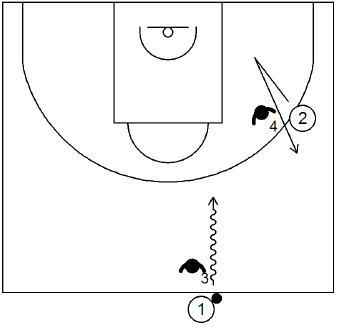
Requirements:
players must be able to run a lay up from a bounce pass
Goal: To learn
how to create scoring opportunities for yourself as a forward
Organization:
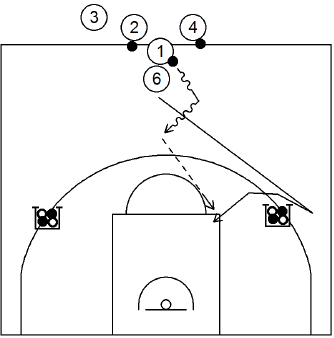
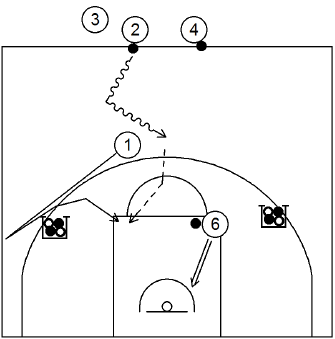
The helpline is out: this allows you to play with two foursomes on one basket and forces players to not use the space where in the game the help is.
- Make it, take it and play to the 5.
- guard dribbles up from the center circle
- at the same time 2 makes a V-cut
- if defender 4 overplays, then extend the V-cut to at least one meter
- above the three-point line and sprint backwards for the backdoor pass.
- if the back pass is not possible because defender 4 stays between the ball and 2
- then 1 dribbles to the wing
- and posts 2 at the block
- gets the ball via a bouce pass from the wing
- and plays 1 against 1
- when defender 4 doesn't pass, 1 passes to 2
- 2 makes one feint and goes hard to the basket
All score from:
- back by
- 1 against 1 from the wing
- 1 against 1 from the block
Mtm offense
If 2 fails to pass, 2 sprints to the center circle and receives the pass from 1. The cycle then starts all over again, but now with 1 at the forward position.
Teaching Points:
- if you can see your defender's shoulder in the passing line at the V-cut, it is a replay
- and you have to take the defender at least one meter above the three-point line towards the sideline.
- print at full speed when your back passes
- the back through pass is mostly one-handed, from the dribble with a flat bounce
- when posting up, first take the defender into the bucket, turn 180 degrees (pin & spin) and land with a hop on the block (both feet outside the bucket line)
Prerequisites:
no specific requirements
Goal: To learn
to use the front cut from the forward position when the defender closes the back door cut.
Organization:
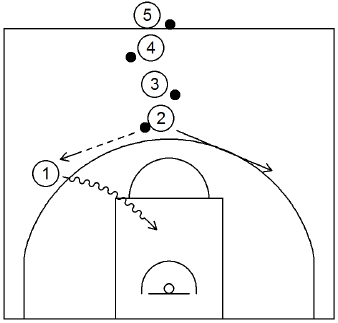
- the dribbler dribbles from the centre circle towards the ball side
- changes direction with an under the buttocks or between the legs towards the guard position on the half way line
- forward pretends to go back, but cuts over the elbow to the basket
- guard players are constantly working on their dribbling skills
Teaching points:
- hard off the outside foot
- cut around the ball box shoulder to shoulder
- Show with your hands where you want to receive the ball
- timing of the pass: should be somewhere near the elbow and in front of the man
Variations:
- different ways of finishing: jump shot, rocker step, fade away, power move etc
- Have the dribbler apply different dribbling skills
- Different passes: bounce from the dribble, overhead etc.
Prerequisites:
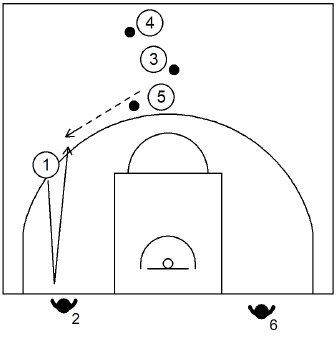
- be able to make a jump stop from the dribble
- make a jump shot from the middle of the bucket
Goal:
learn tocatch
and go + score from the middle of the bucket
Preparation:
- 1 dribbles to the middle of the bucket immediately after catching with 2 dribbles
- stops the dribble with a jump stop
- and scores with a jump shot
- 2 sprints immediately after passing to the forward position at the other side
- and receives the ball from 3
- ditto, but now after the jump stop turn backwards around the defender
- (possibly a chair in the place of the defender)
- same, but after turning backwards, do not finish, but pivot back so that both feet are pointing to the basket again
- Second foot about 50 cm behind the pivot foot.
- score with a jump shot with the shoulders far back (fade away) and a high bow
Teaching points:
- From catching the ball, dribble in quickly and immediately.
- Stop for one second, so you can pivot in both directions.
- When turning backwards, bring the ball up under your chin and put your right hand under the ball
- when turning backwards, turn so far that the foot points at least to the backline
Applied in 1v1:
- 1 taps the hand of defender 2 and sprints to the forward position
- 2 may start to defend after being tapped
- 1 dribbles straight in with max 2 dribbles and makes a jump stop in the middle of the bucket
- and scores in one of the three practiced ways
- score with another technique = lose
- winner stays put
- loser goes to defend
Objective:
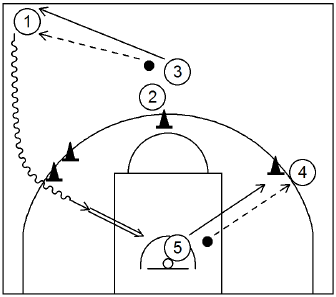
A) feint your dribbleB
) drive to the basket
Organization:
- flow form (pass and chase your ball, take over your predecessor's position)
- the drive to the basket starts at the half way line, against the sideline.
- dribble start
- Feint your dribble
- accelerate
- In line with the free throw line cross the three point line and lay up.
- pass-stations at the guard position and the opposite forward position.
- If necessary, use pawns to determine your position.
- always fake a pass from the ball intake in the opposite direction of the pass. Move the foot and the ball quickly and briefly (on the diagram, the left foot). Then place the foot in front of the ball, release the pivot foot, pass and continue immediately.
- Ball is below knee height, knees bent at 90 degrees.
- Crossover step and with 1 bounce + lay up to the basket.
- catch the ball yourself, put one foot in the direction of the outlet, release the pivot foot, pass and continue directly.
TIP:
Put pawns down as defenders to force change of direction
Teaching Points:
- adjust on the outside hand
- Knees slightly bent on receiving pass
- Protect the ball next to the body
- At every dribble start, the ball and foot should hit the ground at the same time.
- Feints on the pass must be short and fierce.
- move the foot and ball during feints
- after the feint, accelerate on the dribble and finish at top speed
Variations:
- backup dribble (start with the right and continue)
- Tapping during the dribble (start on the right and continue)
- crossover (start on the left, continue with the right and finish)
- start on the right, corssover and finish through the middle with the left
- stop + jump shot instead of lay up
- from the left side
Requirements:
players must be able to individually drive and shoot from the 3-point line
Goal:
train drive, distance shot, rotation and inside-out pass
Organization:
- the teams play 3 against 3 half court
- make it, take it
- only lay ups and 3 pointers are allowed
- play to the 5
Teaching Points:
players without the ball immediately look for a shooting position when a team-mate starts a drive in such a way that the passing line comes open.
Variations:
- mandatory penetration and stop with jump stop or 2TR (= train pivoting and passing out. And you can see if the players without the ball rotate correctly.)
- Mandatory pass fake before a drive or shot = train fakes and create space for yourself
- mandatory cutting after pass (direct score from give and go is allowed) = more traffic in the bucket, so when to penetrate and when not to penetrate. And how do you rotate?
- with a center who is always playable in and around the bucket and can score. = Train shooting and driving in conjunction with the center's movements.
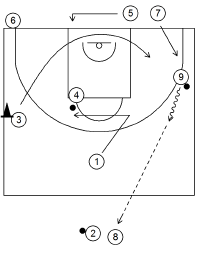
Requirements:
players must be able to run a lay up from a bounce pass
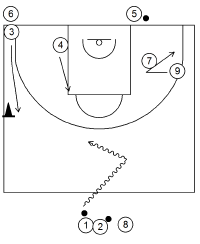
Goal: learn
how to punish the overplaying of the forward by an aggressive defense
Organization:
- guard dribbles up from behind the centre circle
- at the same moment the centre 4 comes to the elbow
- and player 3 sprints to the pawn
- 1 passes to 4 with a bounce pass
- 3 sprints to the basket with a sharp change of direction and speed
- and receives the bounce pass from 4
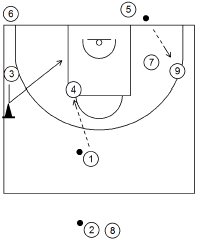
Rotation:
- 4 grabs the rebound
- and takes the ball on the back line
- 3 goes to defend the inbound pass
- when 9 receives the ball, 7 takes position at the sideline for the next inbound pass
- 4 and 5 do not rotate but take turns.
- 1 joins the line behind the pawn
- 9 passes the ball to 8 and joins the row behind it
Variation:
- 1 pretends he is going to put a screen away on the weak side, but cuts to 4 for a hand off
- takes the shot
- OR plays pick and roll with 4
Teaching Points:
- Sprint to the pawn: when passing, you as the attacker must take the defender well outside the three-point line to create enough space for the back door.
- 1 must feint immediately after the pass to be in time for the hand-off.