




Soccerexercises for u19
- All players jog in a square across the field.
- Half of the players have a ball.
- Players with the ball pass to players without the ball, maintaining eye contact.
- The ball must not be held for more than 5 seconds.
- At a whistle signal from the coach, players without the ball sprint to a nearby player with a ball and try to take the ball away.
- Players with the ball try to shield the ball (1:1 duel).
- At the next whistle signal, resume jogging and passing.
- With an odd number of players, the player without a direct opponent receives a task, such as sprinting across the width of the field.
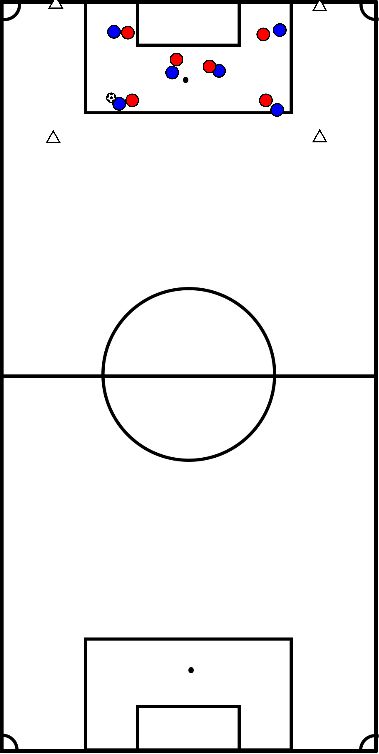
- Duration
- 30 min
- Distance:
- 40 mtr width
- 20 mtr length
- Implementation:
- 2 teams play ball around 10 times gives that team the right to score.
- Other team defends the goal and when in possession of the ball, the team tries to pass the ball around 10 times, giving them the right to score.
- Team that takes the ball away when they have the right to score may score immediately.
- Without goalkeeper so use a 3x1Mtr goal.
- Coach moment:
- Positions in the field also work in 3 lines here.
- Ball possession team rest on the ball and move.
- Defending team compactly screen the goal.
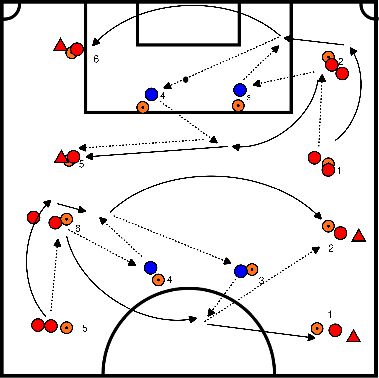
- Very nice warm up 10 minutes
- Player 1 passes the ball to player 2
- Player 2 passes the ball to player 3
- Player 1 runs behind player 2
- Player 3 passes the ball to player 1
- Player 1 passes the ball to player 4 and runs on to the pawn near player 6
- Player 2 runs diagonally left along player 3
- Player 4 passes the ball to player 2
- Player 2 passes the ball to player 5 and then runs on to the pawn near player 5
- When it goes well the speed has to go up.
- When it doesn't go well, the speed has to go down and they always have to receive the ball first.
- When it still goes well, make the field smaller.
- The way back is the same
- Player 5 passes the ball to player 6
- Player 6 passes the ball to player 4
- Player 5 runs behind player 6
- Player 4 passes the ball to player 5
- Player 6 passes the ball to player 3 and runs on to the pawn near player 2
- Player 6 runs diagonally left along player 4
- Player 3 passes the ball to player 6
- Player 6 passes the ball to player 1 and then runs on to the pawn near player 1
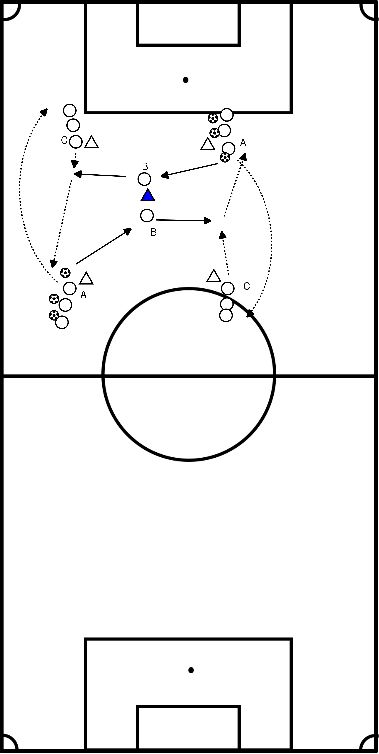
- Duration:
- +-20 min
- Distance:
- From blue pylon 6 m wide and 10 m back
- Execution:
- Players A play to B who turns open and passes the ball to the incoming players C.
- C runs in when A plays in.
- Coach moment:
- A passing at the right speed.
- B asks A for the ball and turns it open at the right speed, passes to C.
- C runs in immediately when A plays in.
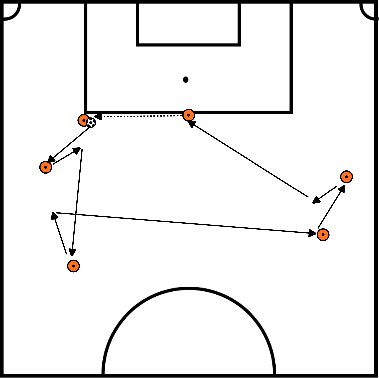
- Comment:
- 4 players from JO17-1 join position play JO19-1.
- That leaves 10 players. (incl. 2 goalkeepers)
- Passing exercise:
- Combination of short passing, handball, opening up, and shifting play.
- Double teaming at the pawns.
- Trainer may join in so that the exercise continues due to the number of players.
- Sequence:
- Pass - handball - check + cross ball - check + short pass - handball - tight low ball - dribble.
- Logical passing.
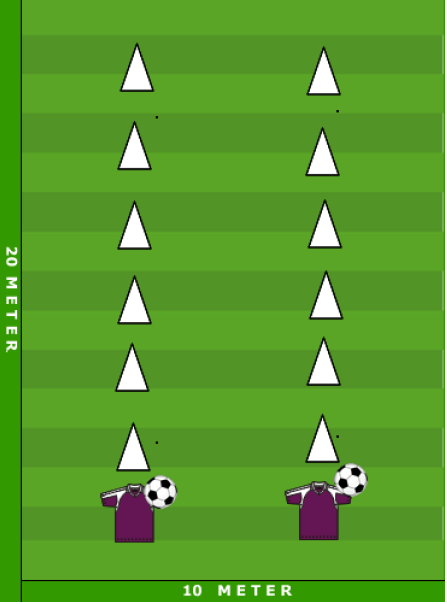
Field position:
Line up 8 to 10 pawns in 2 rows next to each other.
How to play:
Each player tries to slalom through the cones. This must be done by hitting the ball with the inside and the outside of your football boot.
Variations:
- First, make sure the move is done with the inside and with the outside of the foot.
- Play a game between 2 players: who is the fastest.
- To also learn to turn quickly, take the same route back along the cones at the end.
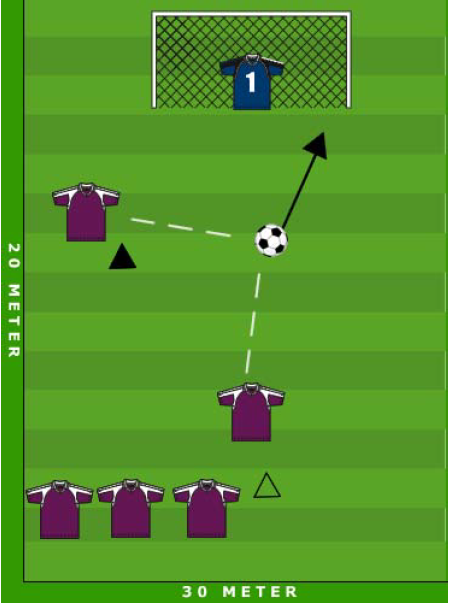
Field position:
1 starting pawn 30 metres away from the goal. One player to pass the ball and the rest of the players behind the starting pawn.
How to play:
From the first left pawn, the ball is passed wide to the emerging player. This player shoots the ball at once at the goal.
Rules/tips:
- Make sure you push your body forward when you shoot otherwise the ball often goes too high.
- Make sure you choose your angle when the goalkeeper is in the middle.
- Make sure you shoot low if the goalkeeper is slightly off his goal
- If the goalkeeper is on the line, you can also shoot high
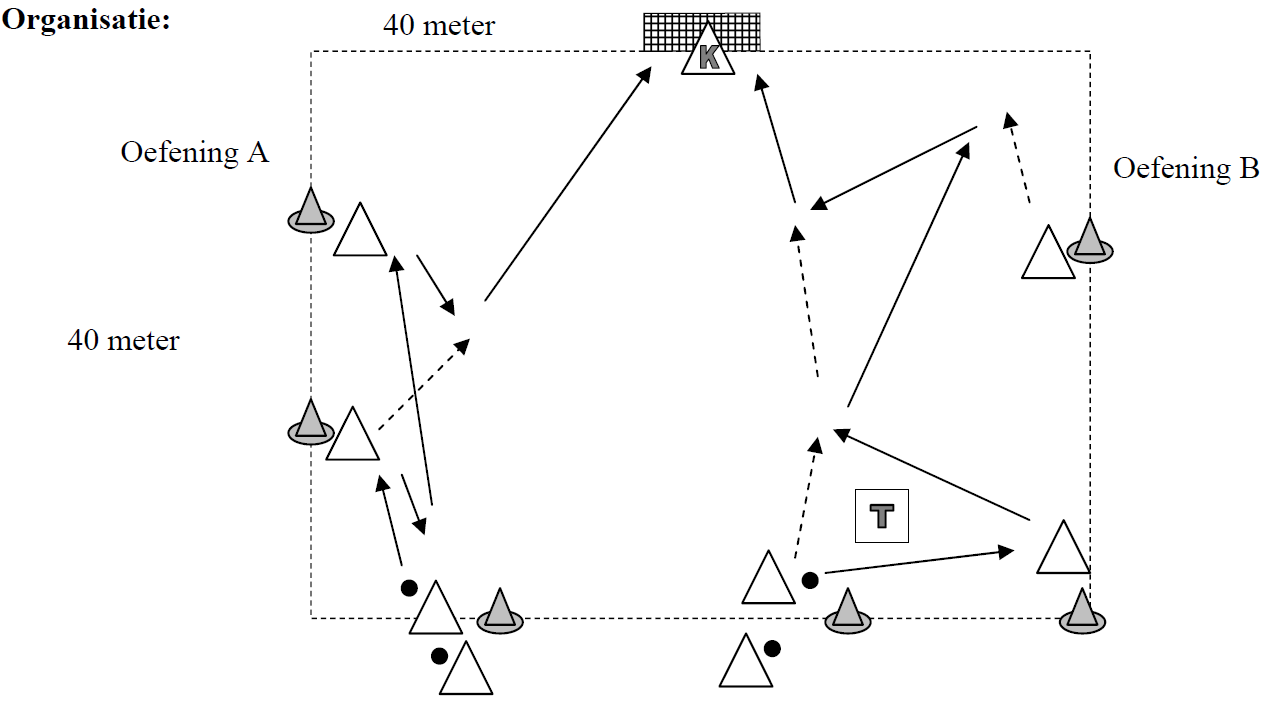
Organization:
Divide the team into 2 groups. Preferably have both groups finish with the same exercise on 2 goals.
Exercise A:
Pass the ball, lay it wide, play into the corner, cross to the striker and finish.
Exercise B:
Pass the ball, lay it wide, play into the corner and cross to the midfielder. After a combination with the striker the midfielder finishes.
If everything goes well you can ask them to score with a volley at the end.
Notes:
Scoring in this exercise is most important. It is allowed to play through the air, as long as this is done accurately
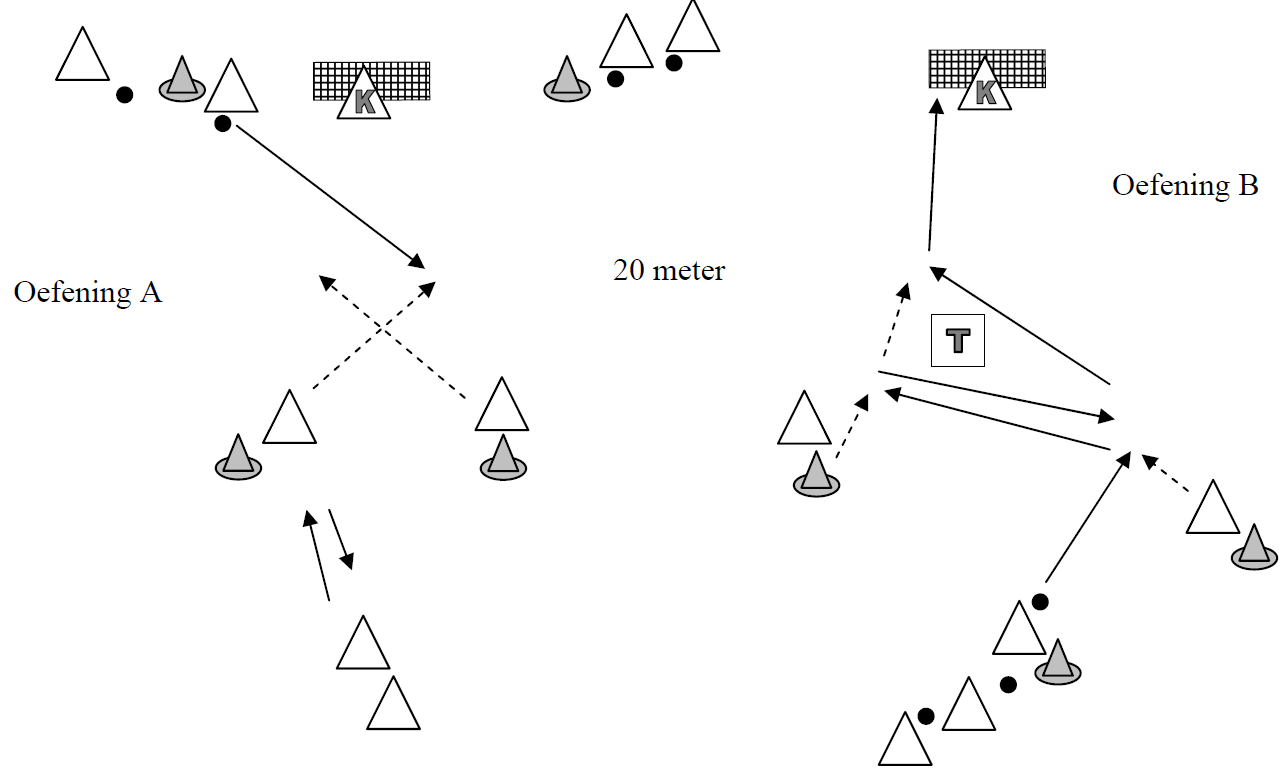
Organisation:
In exercise A the team is divided into two groups, one on the left and one on the right.
A cross is hit from the back line. The incoming attackers cross each other. The player who shot at the goal collects the ball and goes behind. The player who hit the cross becomes the attacker.
In exercise B, the ball is shot on goal after a handball and 1-2 combination. You can do this yourself,
After the exercise has gone well, you can act as defender here.
The players move on.
Points of attention:
Movement towards the ball.
Playing clean and hard.
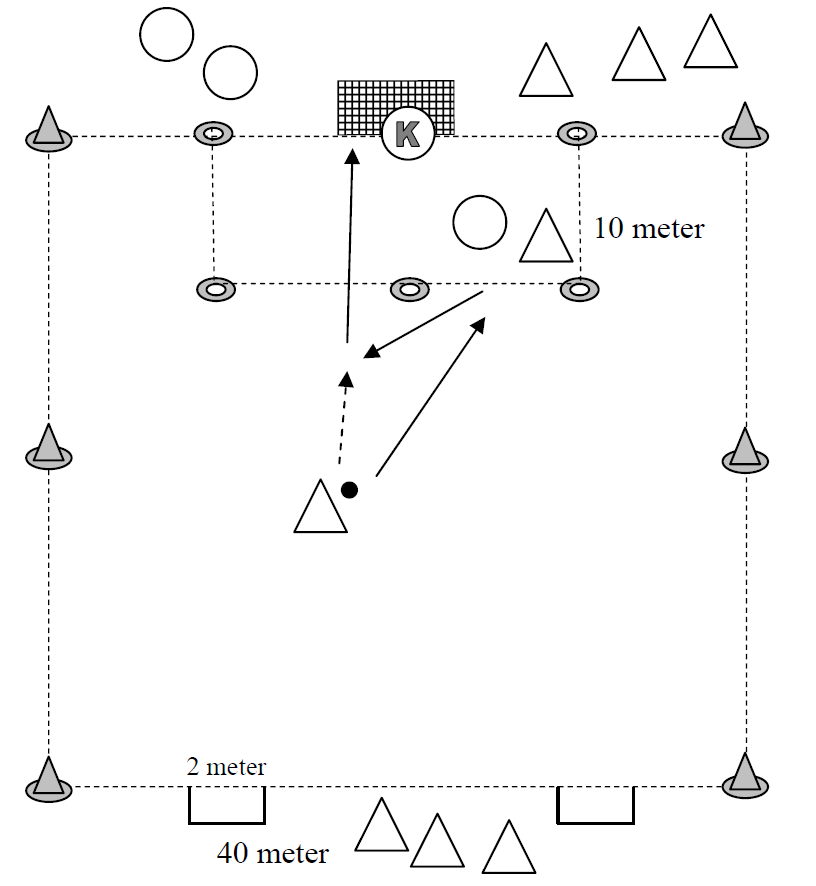
Organization:
2 attackers against 1 defender + a goalkeeper.
The attacking team can score from outside the 10 meter zone by shooting directly after the handball
. If they enter the 10-meter zone, they can choose how to score.
After a chance, missed or hit, or when the ball goes out to the sides, the ball is exchanged.
The defender can score on the 2 small goals.
Points of attention:
Move to the side to make room for your team-mate.
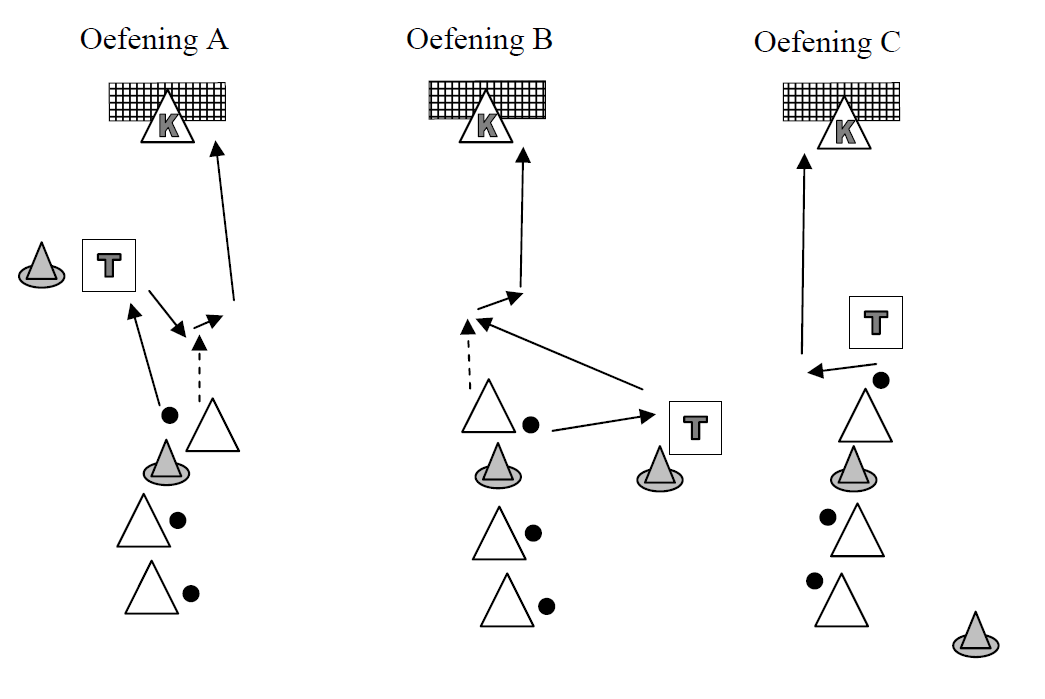
Organization:
Divide the team into two groups. Everyone has a ball. Each group near a goal with a goalkeeper. There are different ways to finish on goal.
Exercise A is with a handball. The players have to set the ball up with the outside of their foot so that they can shoot at the goal in one fluent movement.
In exercise B the ball is played to them from the side. They receive the ball with their left and shoot with their right. If the pass from the trainer comes from the left, they take the ball with the right and shoot with the left.
In exercise C they come up to the trainer and cut the ball with the inside or the outside of the foot. After the cutting movement they must try to shoot directly.
Points of attention:
Look at their standing leg at the moment they shoot.
Do they estimate the ball speed correctly?
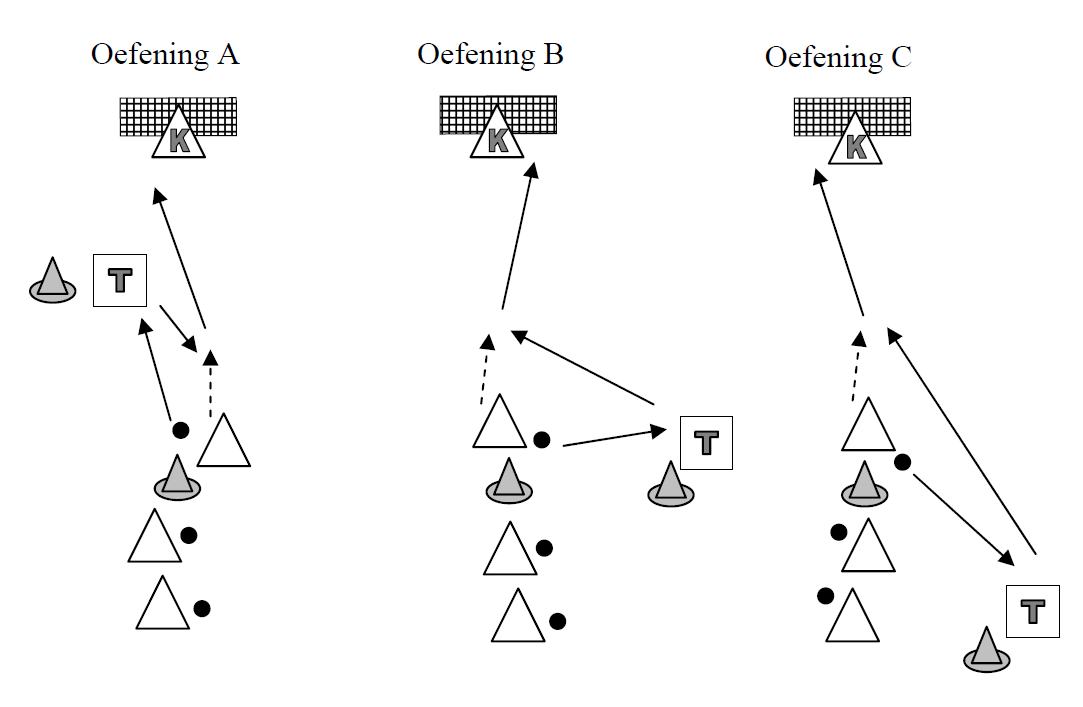
Organization:
Divide the team into 2 groups. Everyone has a ball. Each group near a goal with a goalkeeper.
There are different ways to finish on the goal.
Exercise A is with a handball.
In exercise B the ball is played to them from the side.
In exercise C the ball comes from behind.
If everything goes well, you can also try other variations.
For example: throwing up the ball; throwing the ball over a player who has his back to the goal.
Some remarks:
With F-pupils it is recommended to play handball yourself. This is to keep the pace of the exercise
.
In the second year of E-pupils, you can also let them pass.
Points of attention
Look at their standing leg at the moment of
shooting.
Do they estimate the ball speed correctly?
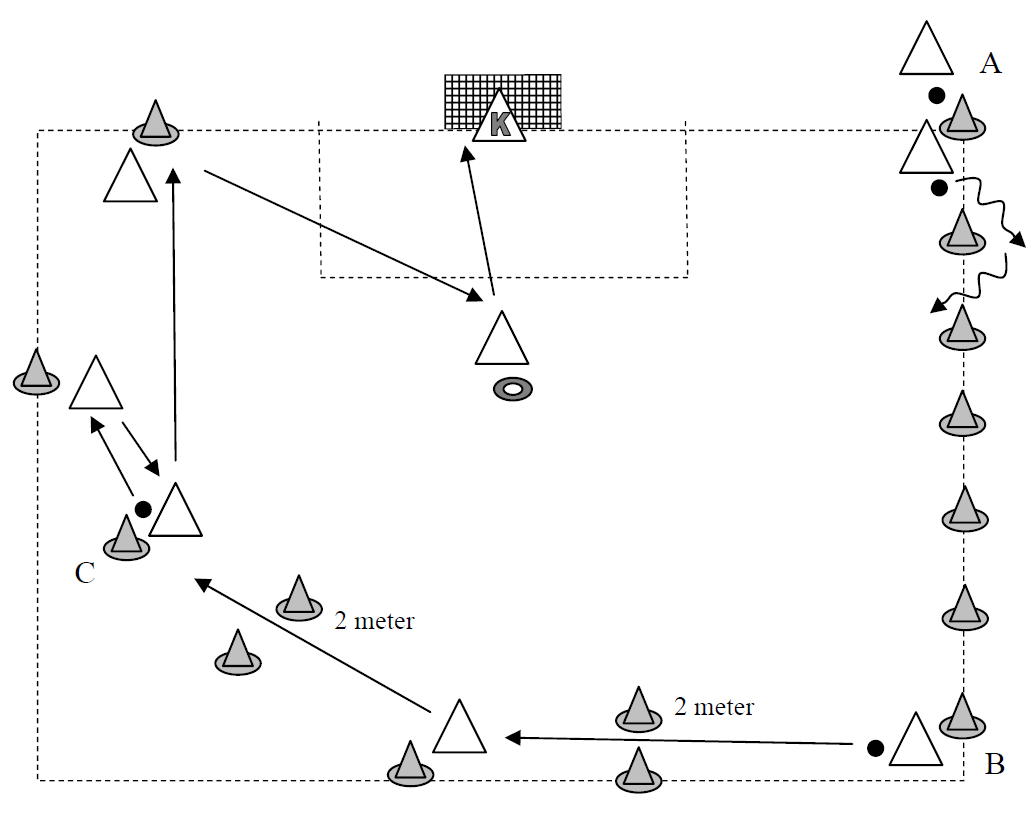
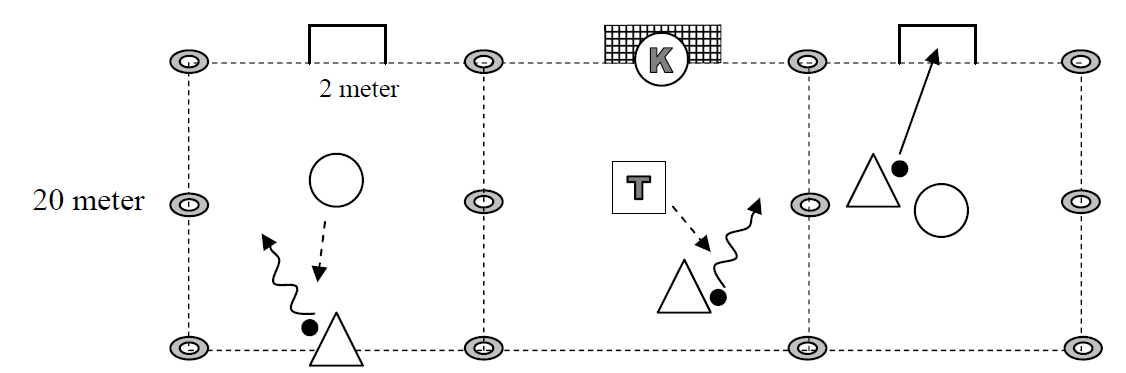
Organisation:
Start with dribbling, then shoot through gates, via a handball comes a cross which is
shotat goal
.
Depending on the number of players you can
startwith 2 balls, on position A and C, or with 3 balls at the same time
.
Everyone shifts one position at a time.
Points of attention
If necessary, accept the ball first.
Dribble with both legs.
Not too hard or soft passes.
Organization:
- Divide the team into 2 groups, 1 group on the left side and 1 on the right side.
- In exercise A they start with a single handball, then quickly move on to a double handball. The
- The first player then finishes the ball.
- In exercise B the ball is given deep after a 1-2 combination, after which a cross follows. Your
- You can act as a defender here.
- The players move on.
- The players must try to keep the ball low.
Points of attention:
Technical execution of the kick with the inside of the foot
:Stand leg; point in the direction of play; bent in the hip, knee and ankle.
Playing leg; turned outward; knee and ankle bent.
Playing foot; perpendicular to the direction of play; sole of the foot parallel to the ground; toes raised;
no weak ankleon the
kick.
A controlled swinging movement.
Technical execution of the kick with the inside of the instep:
Stand leg; 2 to 3 foot widths next to the ball; bent at the knee.
Tackle; on the inside of the spot where the laces begin.
Approach from an angle of approximately 45º.
Organization:
Divide the team into 3 groups. If you have few players you can also make 2 groups and
leave outa goalie
.
They have to pass the passive defender with a feint and then score.
After this, they move on to the next goal.
After a few rounds, you can indicate that you want to see a particular feint
If you are training in pairs, you can also be a defender yourself Now you can decide for each player how
strongly you will defend
If things are going well, you can instruct the defenders to defend at their very
best
Some comments:
You can use nice feints from professional footballers or the players of Balk 1 as an example
.
Points of attention:
Do not use the passing move too far or too close to the opponent.
The body must move with the passing move for it to be successful.
Requirements: Â- players must be able to dribble a layup run
Goal: Â- Increase offensive power in 1 against 1
Organisation
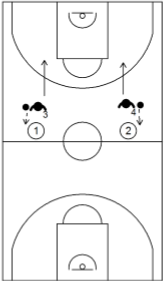
: Player 1 receives the ball from
33 moves backwards1
unbalances 3, passes and goes hard to the basket Mandate
for the defender is to stop the dribble loser
stays on the same side defender winner
attacks on the oppositeside
Teaching Points
:Attacker should aggressively close the distance Right
at the defender Dribble down the defender
Unbalance the defender Attacker
should be unpredictable
Choosing which side to pass on at the last moment
After
passing, move at full speed towards the basket Play
with guts If
you can't, regain your balance, and try another technique, e.g. backup dribble + jump shot
This exercise will improve the passing game. We also increase the difficulty by starting the same exercise at two sides. The passing has already been done for the U23 and U12 but can also be used for younger players.
It is a simple form which can be done in a space of 20m by 20m or smaller. If you want the pass line 3 to be longer and tighter, you have to draw it backwards.
A and D start the exercise together by passing to B and E (1), who then pass the ball back (2). A and D run in on the ball and play diagonally to C and F (3). Here, both players have to be careful not to bump into each other, so vista is important in passing. B and E turn around and ask a 1/2 from C and F (4,5). C and F guide the ball further to the starting position to start again (6). The players continue to advance according to the letter.
A-B-C-D-E-F-A.
You can always run this pass at a high tempo. If you have a younger age group which is a bit sluggish, then allow a ball control in the passing.
The fun aspect is always possible too. You place a small goal in the zone of A and D.C and F try to score a goal after the double pass. The one who scores the fastest is the winner.
This time we have put online a game form in which you play 4vs4 in the middle and each team has 2 more players in a neutral zone on the sides. This type of game has been practiced many times by our teams and first teams. With emphasis on fast passing and deep running.
Age category: U14 to U21 and first team.
This type of game can be played on a 15m x 30m pitch. This depends on the age of the players and the pressure they are under. If you want to play in this shorter space, make it smaller. Otherwise, make it bigger. The endzone is about 2 to 3 m deep.
In the middle you play 4vs4 and on both sides both teams have 2 players who have to play in 1 time.
The 4 middle players try to control the ball in the endzone, but the last pass must be made in 1 time.
As you can see on the picture, the ball is played in by the back player to the outfield player (1), who immediately passes (2). The middle player passes to the furthest player (3), and the furthest player looks for the 3rd man in between, who opens up in the deep (4). The latter then checks the endzone to score.
Like in the picture, you can also place fixed cones or dolls as an extra difficulty.
Of course you can increase the number of ball keys according to the age.
There are always extra rules that you can add. E.g. it should not be the 3rd man to score.
This type of game can be used perfectly in your periodization.
Player A delivers a cross towards the far post to incoming player one. This player tries to finish on goal.
After this it is player B's turn, who sends a cross in the direction of the far post to player two, he also tries to finish.
Player A sends a cross to player three at the far post, player three hits the goal.
Player B sends a cross to player three at the far post, player three shoots at the goal, player four shoots at the goal
.
The players who finish (players one to four), shoot the ball back to the players who cross the ball.
Players one to four swap as follows:
After two to three minutes, the players who finish and cross swap.
Try to do this five times in a row. As an element of the competition you can keep track of which player scores the most goals.
Points of attention
The goalkeepers must be concentrated and ready for the crosses, and have a good starting position.
The goalkeepers are allowed to take the ball at all times
Players who finish on goal run straight at the ball, and not around it.
A rebound may also be completedCoach
the players to time their runs well.
This is a technical football exercise in a pass and kick form.
Mark out a square of 15 by 15 meter.
Place three or four players at all yellow cones. If you have sixteen players or more, it is best to mark out two sections. The exercise starts with four players at the same time. All four players dribble to the blue pawn in the middle of the square. When they reach the blue pawn, they cut the ball off to the left or right.
The first player of pawn A passes to the second player of pawn B. He receives the ball and now it's his turn to dribble to the blue pawn and pass to the left or right.
Player A runs after the ball and thus joins the line at the pawn again, keeping the players in a circle. Make sure all players run in the same direction (left or right). After a while, you can switch between left and right.
Coach moments
The ball touches must be good, make sure the players move on their front feet and have an active position to catch the ball
Make sure that the cutting movement is exaggerated and that the ball is in a good position to be passed into.
The ball should be played in hard again and again, in order to keep up the pace and speed of the ball
The dribbling must also be done at a high speed, with the ball close to the foot.
Variants of this type of exercise: (can be performed with the left or right foot)
Cutting with the inside and outside of the foot
Pull back with the left and then turn open with the right
Step over with the left and then take the ball over with the right
Retrieve with the left and tap the ball with the right behind the supporting leg
Tips
Try out different sizes of box When you have a larger section, you are training for fitness and a tight ball When you have a smaller section, you are mainly training for speed of action
Work through this type of exercise in three to five-minute sessions
Try to ensure that the four players who are walking towards the blue cone start at about the same time
Make sure there are enough balls at pawns A and B.
You can do this exercise with six to eight players.
If you have enough players, you can make two squares.
Explanation soccer training
Player A plays the ball on the ground to his teammate at pawn C. The player at pawn B does the same to the player at pawn D.
The player at pawn C actively asks for the ball from the player at pawn A and then immediately plays it to the player at pawn F.
The player at pawn C first makes a pre-action and then asks for the ball from the player at pawn A, after this, he plays the ball directly to the player standing near pawn F. The player standing near pawn D does the same to the player near pawn C.
Player A and B have passed to Pawns E and F after the pass and are now defenders. The players at Pawns E and F turn away from players A and B who are now at their backs.
Players A and B, after their defensive action, run on to Pawns C and D. The players at Pawns C and D run on to Pawns E and F. The players who have turned away from their defender go to Pawns A and B.
Coaching moments
The ball speed must remain high, so the balls must be hit hard. This is best done over the ground at a short distance (15 to 20 metres) and through the air at a long distance (35 to 40 metres) At a distance of about 8 meters it is best to bounce the ball.
Make sure the players of pawns C, D, E and F have an active attitude and stand on their front feet. They really have to want the ball and must also make a front pass.
Make sure that, after turning in, the players turn open and place their bodies between the defenders and the ball They should also keep the ball close to them When they have opened up, a slight acceleration takes place
- In this game form we play eight against four.
- Do you have more or less players? You can also choose to play six against three, seven against three, seven against four, nine against four or nine against five.
- Make sure you adjust the dimensions of the field with more or less players.
- After five replays, the eight team may score
- The eight team can score after five replays.
- The team with four players can always score
- Every time the ball goes out, after a goal is scored or when the ball is intercepted by the foursome, start the count again.
- Swap after five goals or up to 10 minutes.
- You can adjust the difficulty by having them pass more or less often for a point.
Points of attention
- Correct ball speed
- The ball must be held low over the ground
- The left and right foot must be used
- Takeover with the right foot
- Make a square of 20 by 20 meters.
- Have half of your players (A) with ball scattered on the outside of the square.
- Have the other half of your players (B) stand in the middle of the square, without ball.
Execution:
- Players B move around the middle area and by calling ask for the ball a players A.
- Player A plays the ball to player B, who does the desired action and passes it back to player A.
- Player A must always stand on his toes to make the pass.
- Player B must accelerate slightly when asking for the ball (to outrun a defender in a normal game).
- The tempo is medium to high so you have to switch within 45 seconds and 60 seconds, B to outside, A to inside. You can switch multiple times and have the players make different actions.
quality:
- Each pass should be high quality and accurate.
- Players in the middle must speed up their pace when they get into the ball.
- Players on the side are always on their toes.
- As the difficulty increases, the quality must remain high.
- All balls must stay in the square.
- Don't forget to encourage successes!
Progress
- Build up skills, e.g. 1st time for each group hit 2 times
- Then 1 only hit once
- Then hit only once and play back to another outfield player
- Add a passive defender, the players inside must accelerate to shake off the defender.
- You carry out this warming-up in two lines, for example from one side to the other side of the field or around it.
Execution:
- Players walk at a jogging pace and a few feet away from the player in front of them.
- The coach or a player is leading this warm-up by calling out instructions.
- Example: Walk from sideline to sideline, the captain leads the warming-up.
- He/she shouts e.g. jump, left or right hand on the ground. Another possibility is that the captain calls out “back to feed†and at “go†the two back players sprint forward.
Quality:
- It is a joint, team warm-up. All players keep the same pace.
Progression:
- Back to front, the back players run forward
- Front to back, the front players sprint forward five meters, then walk backwards and join the back of the line.
- Have the players run five metres apart. The back player sprints forward slalomming through the other players, or the front player turns around and sprints backwards slalomming.
- Use this as a conditioning exercise towards the end of a football training session, you can do it for up to 10 minutes.
- You can add all kinds of movements to this exercise. Experiment!
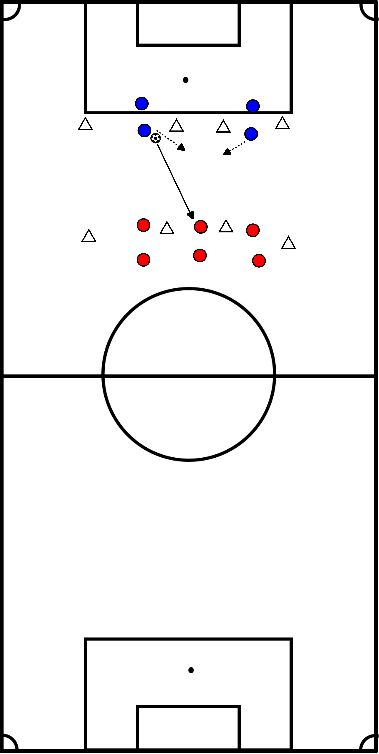
- Duration:
- +- 20 min.
- Distances:
- Width of field.
- Length: 10 meters from center line 2 small goals.
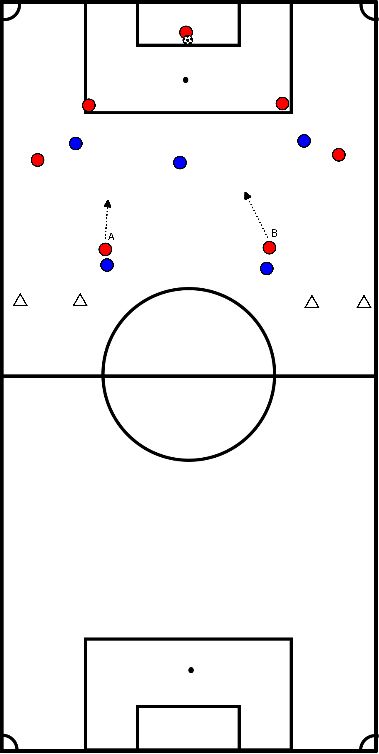
- Execution:
- Goalkeeper kicks the ball from the 5 meters to player A or B.
- From there on red tries to score.
- When blue gets to the ball they can score on the big goal.
- The game is over when a goal is scored or the ball is outside the lines.
- The ball starts again at the goalkeeper.
- Coaching moment:
- Player A and B need to clearly break away from opponent and shield the ball.
- Defending back immediately joins in attack when midfielders get the ball.
- Other back come in as CB immediately.
- PUT PLAYERS WHERE THEY ARE IN THE FIELD.
- Duration:
- +- 20 min
- Distance:
- 10 meters wide
- 15 meters long
- Execution:
- Blue defenders play the ball to the attackers.
- Blue defends the goal.
- Press opponent.
- One player puts pressure.
- Another goes behind it diagonally for back cover.
- Play is over when ball is out or a goal is scored, switch teams.
- Coaching moment:
- Defenders keep calm keep switching well with back cover.
- Attackers high ball tempo field wide keep playing defense.
- Through ball between them.
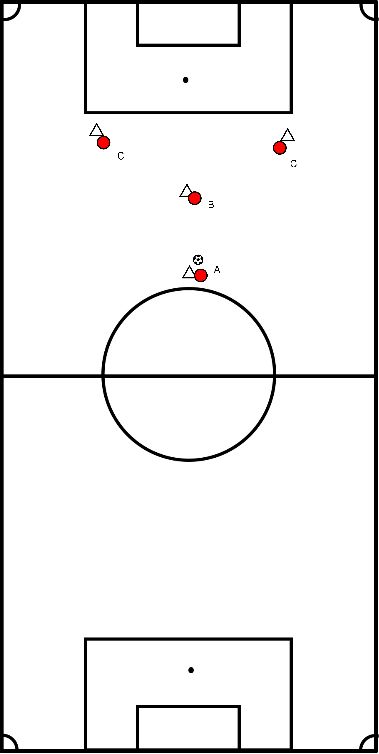
- duration:
- +- 15 min
- distance:
- 10 meters per pawn
- Execution:
- 1:
- A plays B.
- B turns open.
- B plays to C.
- 2:
- A plays to B.
- B bounces back to A.
- A plays to C.
- 1:
- Position switch:
- A to B.
- B to C.
- C to A.
- Coach moment:
- Play directly as much as possible.
- Play balls in such a way that your fellow player can act immediately.
High tempo.
- Make 2 groups.
- Make a competition of who is the fastest all round.
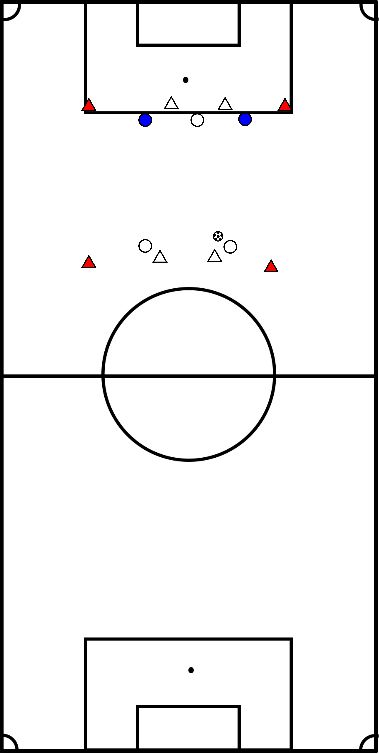
- Duration:
- 20 min
- Distance:
- box 10 by 10 meters
- goals 3-1 in the middle of the line
- Execution:
- 2 to 3
- Middle player of 3 starts on the same line as defenders.
- The builders are required to play the middle player first.
- Then build up to a goal.
- Game is over when one of the 2 parties has scored or the ball is out of the field.
- After that, switch positions
- Coach moment:
- Center player comes loose and shields the ball well.
- Play short combinations so that the other player can act immediately.